


The Unfashionable Dessert
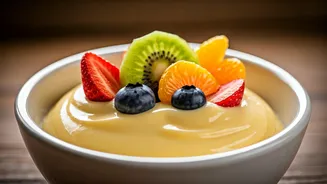
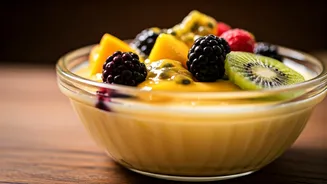
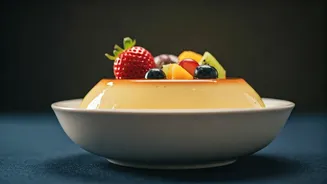
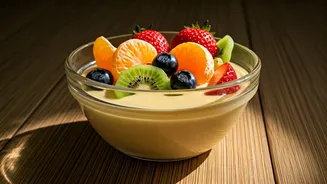
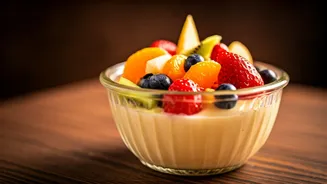
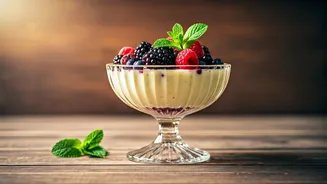
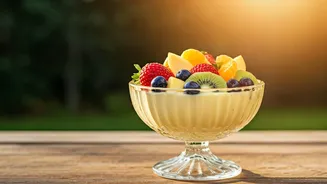
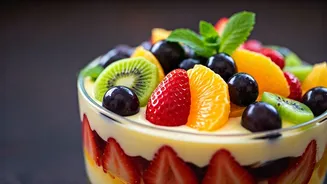
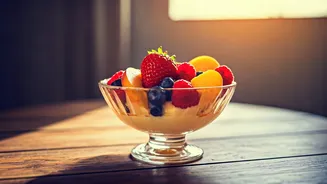
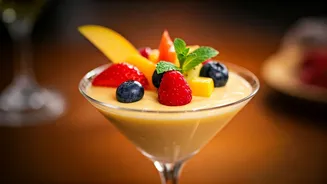
In an age of deconstructed tiramisu and salted caramel everything, fruit custard feels like a relic. It’s a humble assembly of milk, sugar, eggs, and vanilla, cooked gently until it thickens into a creamy, spoonable sauce, then chilled and combined with
fruit. The fruit itself is often a simple affair—canned fruit cocktail, sliced bananas, or seasonal berries. There are no complex techniques, no exotic ingredients. It’s the kind of dessert you’ll find in a church basement, at a summer barbecue, or in a Tupperware container in your grandma’s fridge. And that’s precisely the point. Its lack of pretense is not a weakness; it’s the key to its emotional power. Fruit custard doesn’t compete with the culinary world’s latest trends because it isn’t playing the same game. Its currency is not innovation, but familiarity.
A Blank Canvas for Memory
The sheer simplicity of fruit custard makes it a perfect vessel for memory. Because the base recipe is so straightforward, the small variations are what make it personal. Was your family’s version made with a from-scratch crème anglaise or from a box of Bird’s Custard Powder? Did it feature the controversial fruit cocktail, with its unnaturally red cherries, or was it strictly fresh bananas and Nilla Wafers, like a Southern-style banana pudding? Maybe it was studded with grapes and apples, a nod to its South Asian popularity at parties and celebrations. These subtle differences become family canon. ‘The right way’ to make it is simply the way you remember it. The dessert acts as a blank canvas, and every family paints its own story onto it with slices of fruit and dashes of vanilla. It’s a taste of home, defined by whichever home you happened to grow up in.
The Comfort of Consistency
In a world that feels increasingly complicated, the reliability of fruit custard is a comfort in itself. It is a food of reassurance. It tastes like a time when scraped knees were the biggest problem of the day and a sweet treat could solve almost anything. For many, it evokes a specific kind of domestic love—unfussy, dependable, and quietly present. It wasn’t made to be photographed for Instagram; it was made to be eaten. It was made to stretch a budget, to use up fruit that was about to turn, or to bring a simple, sweet end to a family meal. This connection to thrift and practicality grounds it in a reality that feels more authentic than the curated perfection of modern food culture. The dessert promises nothing more than what it is: a sweet, creamy, fruity bowl of comfort. And in that, it always delivers.
Why Nostalgia Is an Ingredient
Food scientists talk about flavor compounds and mouthfeel, but they can’t isolate the feeling of being seven years old at your aunt’s dining table. That’s the ingredient nostalgia adds. When we eat fruit custard, we aren't just tasting milk and sugar. We're tasting the memory of the people who made it for us, the sound of laughter in a familiar room, the specific light of a long-gone summer afternoon. Neurologically, taste and smell are deeply intertwined with the memory centers of the brain. A spoonful of custard can trigger a cascade of associations that are far more powerful than the sum of its physical parts. It doesn’t just nourish the body; it nourishes a connection to our past, to our family, and to the person we used to be. The custard itself is just the delivery system for something much richer.