






1. Your Tires
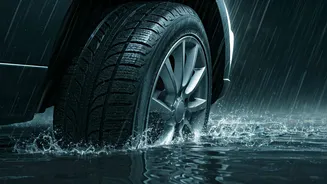
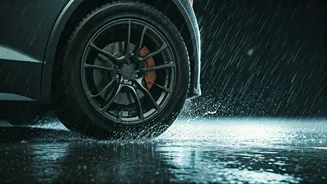
Your tires are the only part of your car actually touching the road, making them your first line of defense against hydroplaning. Before the rainy season kicks in, inspect their tread depth. The classic trick works: place a penny upside down in a tread groove.
If you can see all of Abraham Lincoln's head, your tires are worn and it's time for a new set. Properly inflated tires are just as important. Under-inflation causes the tire to flex too much, reducing its ability to channel water away. Check your car's door jamb for the correct PSI and ensure your tires are filled accordingly.
2. Windshield Wipers
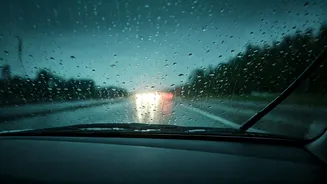
This seems obvious, but worn-out wipers are a massive safety hazard. If your blades are streaking, chattering, or leaving patches of water behind, they aren't clearing your windshield effectively. Over time, the rubber hardens and cracks from sun exposure. Lift the wiper arm and run your finger along the blade's edge; if it feels brittle or has nicks, replace it. Wipers are inexpensive and can usually be replaced in minutes without any tools. Don't wait for a downpour to discover yours are useless.
3. All Exterior Lights
In a heavy storm, visibility plummets for everyone. Functioning lights help you see the road and, just as crucially, help other drivers see you. Walk around your car and check your headlights (both low and high beams), taillights, brake lights, and turn signals. Have a friend or family member stand behind the car and confirm your brake lights activate when you press the pedal. Many states have laws requiring headlights to be on when wipers are in use, so ensuring they all work is a matter of both safety and compliance.
4. The Brake System
Wet roads significantly increase your vehicle's stopping distance. This makes having a fully functional braking system absolutely critical. While a full brake inspection is best left to a professional, you can perform a basic check. Listen for any high-pitched squealing, scraping, or grinding sounds when you apply the brakes—these are tell-tale signs of worn pads. Also, pay attention to how the pedal feels. If it feels spongy, soft, or sinks to the floor, it could indicate a leak or air in the brake lines. Any of these symptoms warrant an immediate trip to the mechanic.
5. Defroster and Air Conditioning
Rainy weather creates a perfect storm for foggy windshields. The combination of cool rain on the glass and your own breath inside the car can quickly obscure your view. Your defroster and A/C system are your best tools for combating this. Turn them on to make sure they're blowing air effectively. The A/C is particularly important because it removes moisture from the air inside the cabin, clearing the glass much faster than heat alone. A system that only blows weak or warm air won't be able to keep up in a heavy downpour.
6. Windshield Washer Fluid
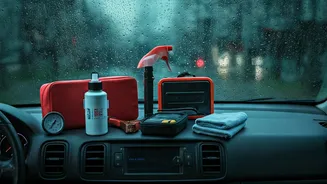
While you might associate washer fluid with clearing away bugs in the summer, it's essential in the rain, too. Heavy rain kicks up a grimy, oily mist from the road surface that gets sprayed onto your windshield by the cars in front of you. Your wipers alone will just smear this film around, making a bad situation worse. A quick spray of washer fluid can cut through the grime and restore clear vision instantly. Topping off your reservoir is one of the easiest and cheapest bits of 'car insurance' you can get.
7. Battery and Terminals
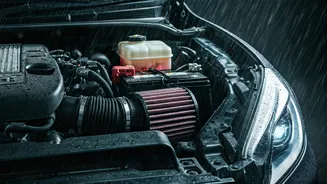
A car battery works harder in damp, cold weather. Furthermore, you're putting more strain on it in the rain by running your wipers, headlights, and defroster simultaneously. Before the bad weather hits, pop the hood and take a look at the battery terminals. If you see a crusty, white or blue-green buildup (corrosion), it can prevent the battery from charging and starting properly. This corrosion can be cleaned with a simple wire brush. Also, ensure the cable clamps are tight and don't wiggle. A weak battery that might have started your car just fine on a sunny day can easily fail you in a storm.