






A City Holding Its Breath
For American travelers accustomed to the idea of India as a land of vibrant chaos, Udaipur offers a different kind of magic. It’s a city of regal white palaces and intricate havelis built around a system of man-made lakes. But for much of the year, the water
levels recede, and the landscape can feel thirsty, waiting for relief. The arrival of the monsoon isn’t just a weather event; it’s a city-wide celebration of renewal. When the rains finally sweep across the Aravalli Hills, they cascade down to replenish the interconnected network of lakes that are the city’s lifeblood. The parched earth drinks deeply, the dusty air is washed clean, and a deep, verdant green begins to emerge, transforming the landscape from beige to brilliant.
Pichola's Glistening Transformation
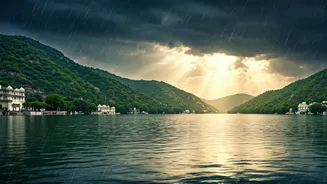
The heart of this transformation is Lake Pichola. As its waters rise, the entire visual grammar of the city changes. The sprawling City Palace, a magnificent complex of courtyards and balconies that towers over the eastern bank, no longer just sits beside the lake; it appears to float on a vast, shimmering mirror. Its reflection, once truncated by low water lines, now stretches across the surface in a perfect, rippling duplicate. Out in the middle of the lake, two iconic island palaces—the gleaming white Taj Lake Palace and the sandstone Jag Mandir—shed their isolation. No longer perched on exposed rock, they become what they were always meant to be: ethereal sanctuaries accessible only by boat, their foundations completely submerged, creating an illusion of structures born from the water itself.
The Domino Effect of Abundance
Udaipur’s beauty isn’t confined to a single body of water. The city was designed with a sophisticated system of interconnected lakes, and the monsoon’s generosity creates a stunning chain reaction. As Lake Pichola fills, its overflow spills into other bodies of water like Fateh Sagar Lake, another popular hub for boating and recreation. The sight of the water cascading from one full lake to the next is a spectacle in itself, drawing locals who understand its profound significance. This flow brings life to the city’s ghats—the wide stone steps leading down to the water—which become bustling hubs of activity. The sound of lapping water replaces the quiet of the dry season, and the entire city feels more alive, more connected, more complete.
The Romance of a Rooftop View
While boat rides on the newly filled lakes are essential, the true romance of monsoon-season Udaipur is often found from above. The city is famous for its rooftop restaurants and hotel terraces, which offer panoramic views of the water and palaces. During this season, they become front-row seats to a spectacular daily show. Guests can sit with a cup of chai, watching dramatic storm clouds roll in over the hills, feeling the cool breeze that precedes the downpour, and then witnessing the city glisten as the sun breaks through again. The play of light on the water, the mist rising from the lake surface, and the distant silhouettes of palaces against a moody sky create a deeply atmospheric and romantic setting that is impossible to replicate at any other time of year. It’s a view that feels less like a landscape and more like a living painting.