

The Solar System's Guardian
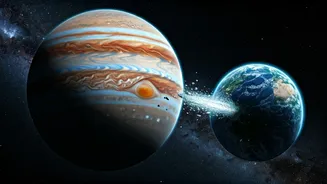
In the story of our solar system, Jupiter has always been cast as the hero—a colossal bouncer standing guard over the inner planets. With a mass more than twice that of all other planets combined, its gravitational pull is immense. For years, the prevailing
theory was that Jupiter acts as a cosmic shield, deflecting or capturing potentially hazardous comets and asteroids that would otherwise be on a collision course with Earth. Without our gas giant, the argument went, Earth would have been subjected to a much more intense and prolonged bombardment, possibly preventing life from ever gaining a foothold. This image of Jupiter as a steadfast protector has been a cornerstone of our understanding of planetary habitability, suggesting that a large, distant planet might be a prerequisite for a safe world like ours.
A New Role: Cosmic Delivery Service
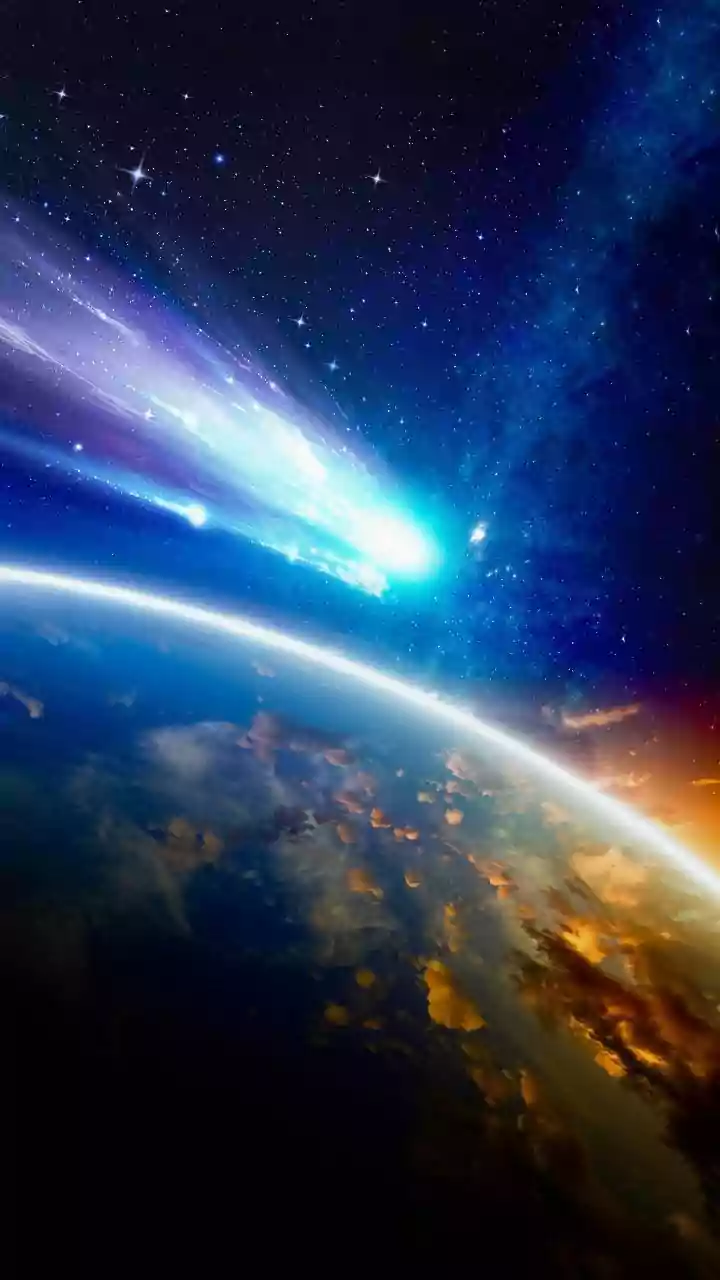
Recent research, however, is painting a more complex and fascinating picture of Jupiter's role. Instead of being just a bouncer, it may have also been the delivery driver. Scientists are now exploring the idea that Jupiter’s powerful gravity was instrumental in knocking the right kind of materials out of the outer solar system and sending them hurtling toward early Earth. These weren't just any space rocks; they were likely carbonaceous asteroids and comets, celestial bodies rich in the very things needed to jump-start life. These objects are packed with water and organic compounds—the fundamental chemical building blocks of everything from amino acids to DNA. In this revised narrative, Jupiter isn't just a shield; it's an essential part of the supply chain that made Earth a living world.
How the Delivery Might Have Worked
So, how could one planet do both? The answer lies in the chaotic dance of the early solar system. According to leading models like the "Grand Tack hypothesis," Jupiter didn't form in its current, stable orbit. Instead, it likely migrated inward toward the sun before tacking back outward, like a sailboat changing direction. This colossal journey would have wreaked havoc on the asteroid belt, which was then much more densely populated. Jupiter’s gravitational nudging would have acted like a giant slingshot, flinging some objects out of the solar system entirely while sending others—particularly those from the outer, icier regions—careening toward the inner planets. It was a messy, violent process, but it may have been precisely the disturbance needed to seed a young, barren Earth with water and carbon-based molecules.
Finding the 'Goldilocks' Giant
This theory introduces a new layer of nuance to what makes a planet habitable. It’s not enough to just have a giant planet acting as a shield. The timing and nature of its influence are critical. If Jupiter's gravitational pull were too disruptive, it could have destabilized Earth's orbit, sending our planet into the sun or out into deep space. If it were too gentle, those life-giving asteroids might have stayed locked in the outer solar system, leaving Earth a dry, sterile rock. The emerging consensus is that Jupiter’s influence was “just right.” It provided enough of a gravitational kick to deliver the necessary ingredients without creating an environment so chaotic that life couldn't survive. This delicate balance suggests that the architecture of a solar system plays a profound role in a planet's potential for life.
What This Means for Life Elsewhere
This revised understanding of Jupiter's role has significant implications for the search for extraterrestrial life. For a long time, astronomers hunting for exoplanets focused on finding Earth-sized worlds in the “habitable zone”—the orbital ring where liquid water can exist. But this new research suggests we should also be looking at the system's broader structure. A truly habitable system may need a “Jupiter-like” planet in the right place to perform this dual role of protector and delivery agent. Systems without a gas giant, or with one that's too close or too massive, might be less likely to host life. It refines our search, reminding us that a planet isn't an island; its potential for life is deeply connected to its entire cosmic neighborhood.