


The Palace of Winds (Hawa Mahal)
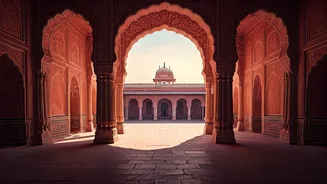
At first glance, Hawa Mahal appears not as a building, but as a colossal, ornate screen. This five-story honeycomb of pink and red sandstone is less a palace and more a poetic facade, built in 1799 for a very specific purpose. Its 953 intricately carved
windows, or jharokhas, were designed to allow the royal women of the Rajput court to observe street festivities unseen. The surrealism lies in its function—or lack thereof. Behind the breathtaking exterior, the “palace” is surprisingly shallow, consisting mostly of corridors and platforms. It’s a structure built for looking out, not for living in; a paradox of public view and private seclusion that stands as an icon of both ingenuity and social structure.
The Celestial Playground (Jantar Mantar)
Stepping into Jantar Mantar feels like stumbling upon a modernist sculpture park designed by giants. This UNESCO World Heritage site is actually an 18th-century astronomical observatory, a collection of 19 colossal instruments built by Maharaja Jai Singh II. The largest of these, the Samrat Yantra, is a sundial that stands nearly 90 feet tall, its shadow moving at a visible pace of about a millimeter per second. The structures are geometrically precise yet profoundly abstract. They are tools of science that look like works of art, creating a surreal landscape where stone and sky converge to measure time, track stars, and predict eclipses with an accuracy that remains startling today.
The Courtyards of the City Palace
While many palaces are monolithic, Jaipur's City Palace is a sprawling complex of courtyards, gardens, and buildings that feels like a city within a city. The dreamlike quality comes from its vibrant, almost hallucinatory details. The most famous spot is Pritam Niwas Chowk, or the “Courtyard of the Beloved,” which features four gates representing the four seasons. The Peacock Gate, with its dazzling, three-dimensional array of sculpted birds, is a social media star for a reason—it’s an explosion of color and craftsmanship. Walking through the palace is a journey through layers of Rajput, Mughal, and European architectural styles, a sensory overload of intricate tilework, gilded ceilings, and opulent doorways that blur the lines between history, art, and fantasy.
The Mirrored Fortress (Amer Fort)
Perched on a forested hilltop overlooking Maota Lake, Amer Fort (also known as Amber Fort) is a breathtaking statement of power and beauty. The initial approach, often made by elephant or jeep up the winding stone path, feels like entering a medieval epic. But the true surrealism is found deep within its walls, in the Sheesh Mahal, or “Hall of Mirrors.” This chamber, built for the empress, is a marvel of Mughal artistry. Its walls and ceilings are covered in thousands of tiny, convex mirror mosaics and colored glass. The design is so intricate that a single candle flame, when lit, can illuminate the entire room, reflecting in the mirrors to create the illusion of a starry night sky. It's a space designed to dissolve reality into a glittering, endless reflection.