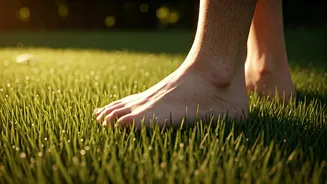










So, What's the Big Idea?
At its core, this practice is about more than just feeling the grass between your toes. It’s often referred to by proponents as “earthing” or “grounding.” The central theory of the earthing movement is that modern life, with its rubber-soled shoes and
indoor environments, has disconnected us from the planet’s subtle electrical charge. Proponents believe that by making direct skin contact with the ground—be it grass, sand, or dirt—we can absorb free electrons from the Earth’s surface. This, they claim, helps stabilize our own physiology, acting as a natural antioxidant and anti-inflammatory force. While it sounds like something from a sci-fi novel, the concept has spawned a dedicated following, complete with books, documentaries, and specialized products like grounding mats and patches for those unable to get outside.
The Promised Perks of Grounding
Ask someone who swears by their daily barefoot walk, and you’ll hear a laundry list of life-changing benefits. The most common claims include reduced inflammation, less chronic pain, deeper sleep, and a significant drop in stress and anxiety. Some small-scale studies, often cited within the grounding community, have suggested potential improvements in cortisol rhythms, blood viscosity, and mood. However, the appeal runs deeper than these specific health markers. The “mindful” aspect is key. The act of walking barefoot forces you to slow down. You have to pay attention to where you step, feel the texture of the ground, and notice the temperature. In a world of constant digital distraction, this deliberate, sensory experience is a powerful form of mindfulness—a practice with well-documented benefits for mental health, supported by a mountain of evidence completely separate from earthing theories.
A Reality Check on the Science
This is where things get a bit complicated. While the benefits of mindfulness and spending time in nature are robustly supported by mainstream science, the specific claims of “earthing” are on much shakier ground. The scientific community at large remains highly skeptical. Most studies on grounding are small, have methodological flaws like a lack of proper blinding, or are funded by individuals and companies with a vested interest in the practice. Critics argue that the purported benefits are more likely attributable to the placebo effect or the undeniable psychological perks of being outside and relaxing. Simply put, there is no strong, independent, peer-reviewed evidence to support the idea that absorbing electrons from the Earth has a significant physiological impact. The real magic is likely happening in your head, not through your feet.
Before You Kick Off Your Shoes
Even if the primary benefit is psychological, there’s little harm in a mindful stroll on a soft lawn, right? For the most part, yes. But it’s wise to be practical. The world is not a pristine, barefoot-friendly paradise. Public parks and lawns can be treated with pesticides and herbicides you don’t want absorbing into your skin. There’s also the risk of stepping on sharp objects like glass, thorns, or rocks. And let’s not forget about bacteria, fungi, and parasites—like hookworm, which can penetrate the skin, though it's rare in well-maintained lawns in the U.S. Finally, watch out for less-than-pleasant surprises left behind by local wildlife or neighborhood pets. It’s best to choose a safe, familiar, and clean space, like your own backyard, and always give your feet a good wash afterward.