



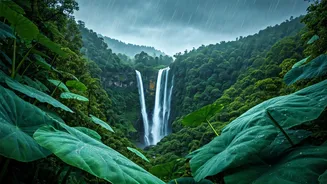


Welcome to the Wettest Place on Earth
Deep in the rolling Khasi Hills of Meghalaya, a state in Northeast India known as the “Abode of the Clouds,” lies the village of Mawsynram. This isn't just any rainy town; it holds the Guinness World Record for the highest average annual rainfall on the planet.
We’re talking about an astonishing 467 inches of rain per year. For comparison, famously drizzly Seattle gets about 38 inches. In Mawsynram, rain isn't a meteorological event; it's the very essence of existence. But instead of a dreary, waterlogged wasteland, this perpetual downpour creates a landscape of almost supernatural beauty, a world washed clean and pulsing with life.
A World Washed Anew
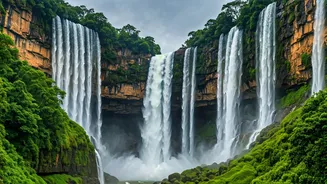
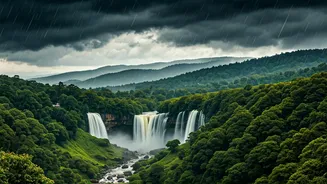
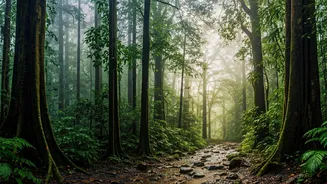
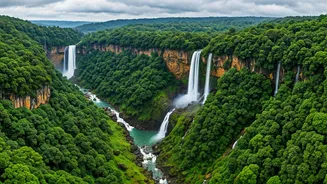
Visiting Mawsynram during the monsoon is to step into a fantasy novel. The color green becomes an all-consuming force, covering every surface in a hundred different shades of emerald, jade, and moss. Hills that are merely pretty in the dry season transform into vertical gardens, with thousands of temporary waterfalls cascading down their faces, roaring into valleys filled with mist. The clouds don't hang above you; you walk through them. They drift through the village streets and pour over the hillsides like a slow-motion river, creating a sense of quiet, dreamlike isolation. It’s a place where you don't just see the landscape, you feel it, hear it, and breathe it in.
The Symphony of the Rain
The magic of Mawsynram is also auditory. The monsoon is not a monotonous drizzle; it’s a complex symphony. You’ll learn to distinguish the gentle pitter-patter on a tin roof from the heavy, percussive drumming on broad-leafed plants. You’ll hear the distant roar of a swollen river and the close-up gurgle of a newly formed stream. The constant sound of water becomes a soothing white noise, washing away the clamor of modern life. It forces a slower, more contemplative pace. Life in the village, for locals and visitors alike, revolves around it. You don’t fight the rain; you find a cozy spot with a cup of hot chai and simply listen.
Life Adapted to the Clouds
The people of the Khasi tribe who inhabit this region have developed a beautiful and resilient culture in harmony with their extreme climate. They don't hide from the rain; they work with it. You'll see villagers wearing traditional “knups,” unique turtle-shell-shaped umbrellas made of woven bamboo and leaves, which allow them to work in the fields with both hands-free. But their most breathtaking innovation is architectural. Instead of building bridges that would be washed away by powerful monsoon floods, they guide the aerial roots of rubber fig trees across rivers. Over decades, these roots grow and intertwine to form incredible living root bridges—strong, resilient structures of pure, living wood that only grow stronger with time and rain. Walking across one is an unforgettable experience, a testament to patience and a profound connection with nature.