







Why Go DIY with Your Cleaner?
Before you grab another plastic bottle of all-purpose spray, consider what’s sitting in your fruit bowl. The journey to a more sustainable household often starts with small, simple swaps, and this is one of the most satisfying. By making your own cleaner
from citrus peels, you're tackling several problems at once. First, you're upcycling kitchen scraps that might otherwise end up in a landfill, where they produce methane. Second, you're drastically reducing plastic waste by refilling the same spray bottle again and again. Finally, you’re taking control of the ingredients used in your home, swapping out mysterious chemicals and volatile organic compounds (VOCs) for a natural, biodegradable alternative that’s safe for most surfaces and smells genuinely fantastic. It’s a win for your wallet, your home’s air quality, and the planet.
What Is This 'Enzyme' Cleaner, Really?
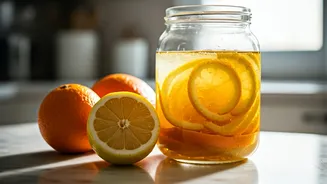
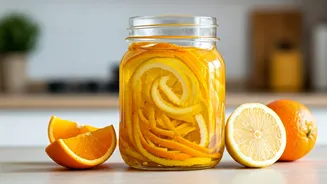
The term “enzyme cleaner” has become a popular shorthand, but it’s helpful to know what’s actually happening in that jar. True commercial enzyme cleaners use specific, isolated enzymes to break down particular stains like proteins or starches. Your DIY version is a bit more rustic, but no less effective for everyday jobs. It’s more accurately a fermented citrus solution. By combining citrus peels (full of oils and acids), sugar (food for microbes), and water, you are kicking off a fermentation process. Wild yeasts and bacteria present in the air and on the peels consume the sugar, creating alcohol and beneficial organic acids, primarily acetic acid—the same active component in vinegar. It’s this acidic, slightly alcoholic brew, infused with the powerful degreasing citrus oils (like d-limonene), that gives your homemade cleaner its punch.
Your Step-by-Step Fermentation Guide
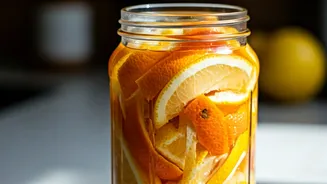
Ready to get started? The process requires more patience than effort. Here’s what you’ll need: * **A large, sealable container:** A 2-liter plastic soda bottle or a large glass jar with a screw-on lid works perfectly. Plastic is often preferred as it’s less likely to shatter under pressure. * **Citrus peels:** Any kind will do—orange, lemon, lime, grapefruit. Aim for roughly 3 parts peels. * **Brown sugar:** This is the catalyst for fermentation. You’ll need 1 part sugar. * **Water:** Use 10 parts water. **The Recipe (by ratio):** Combine 1 part brown sugar, 3 parts chopped citrus peels, and 10 parts water in your container. For a 2-liter bottle, this might look like 1 cup of sugar, 3 cups of peels, and 10 cups of water. Screw the lid on tightly. For the first two weeks, you must “burp” the container daily by loosening the cap to release the built-up fermentation gases. After that, you can release the gas weekly. Store the container in a cool, dark place for three months. Yes, three months! This is a slow, natural process. Your patience will be rewarded.
Troubleshooting and What to Expect
During the three-month wait, you might have questions. A healthy ferment should smell sweet, sour, and citrusy, like a strong kombucha. If it smells rotten or putrid, something has gone wrong, and you should discard it and start over. This is rare if you follow the ratios. You may see a layer of sediment at the bottom or a jelly-like film (a SCOBY, similar to kombucha's) on top—these are normal signs of a healthy fermentation. If you see spots of black or fuzzy green mold, it usually means the peels weren't fully submerged. You can try to skim it off, but it’s often best to start again, ensuring all solids stay below the liquid line. The final liquid should be brownish-orange and fragrant.
How to Use Your Finished Cleaner
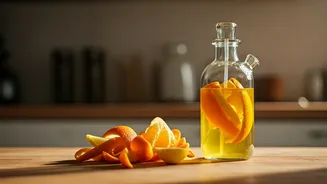
Congratulations, you’ve made it! After three months, your powerful cleaning concentrate is ready. Strain the liquid through a cheesecloth or fine-mesh sieve to remove all the peel solids (which can be composted). Store this concentrate in an airtight bottle. For general cleaning, you’ll want to dilute it. A good starting ratio is 1 part concentrate to 3 parts water in a spray bottle. Use this solution to: * **Degrease your stovetop and backsplash.** The citrus oil is a natural solvent for grease. * **Mop your floors.** Add a half-cup to your mop bucket for a streak-free shine and a fresh scent. * **Clean windows and mirrors.** The acidity helps cut through grime without leaving streaks. * **Wipe down counters and surfaces.** Because it is acidic, avoid using it on natural stone surfaces like marble, granite, or travertine, as it can cause etching over time. Otherwise, feel free to experiment with your powerful, homemade, zero-waste cleaning solution.