





A Private Screening
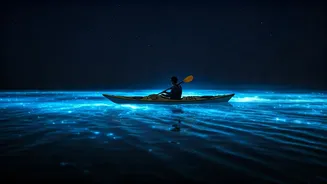
Imagine floating in a kayak on the inky black waters of the Bay of Bengal. The air is warm and still, thick with the scent of salt and jungle. Above you, a canopy of stars glitters, unobscured by city lights. But the real show is happening below. You
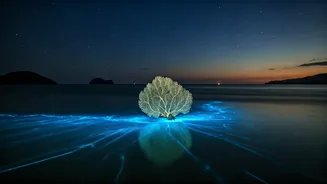
dip your paddle into the sea, and the water erupts in a swirl of electric blue and green light. Every movement—the glide of your kayak, the flick of a fish beneath the surface, even the trail of your hand skimming the water—creates a corresponding burst of shimmering, ethereal light. It’s a silent, breathtaking performance. This isn't a special effect; it's bioluminescence, a natural phenomenon that transforms the Andaman nights into an otherworldly dreamscape, and you have a front-row seat.
The Science Behind the Sparkle
The stars of this nightly show are microscopic, single-celled organisms called dinoflagellates, specifically a species known as *Noctiluca scintillans*, or “sea sparkle.” These tiny phytoplankton float near the surface and possess a remarkable defense mechanism. When disturbed by motion—a wave, a paddle, a swimming fish—a chemical reaction inside their cells produces a flash of light. Scientists theorize this is a “burglar alarm” system. The flash illuminates the predator trying to eat the plankton, making that predator visible to larger hunters in the food chain. For the dinoflagellates, it’s a life-or-death distress signal. For us, it’s pure, unadulterated magic. The light isn’t hot; it’s a “cold light” created with incredible efficiency, a process that continues to fascinate biologists.
Finding the Glow
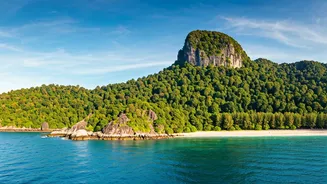
While this phenomenon can occur in oceans worldwide, the conditions in the Andaman and Nicobar Islands, a remote Indian archipelago, are uniquely perfect for a spectacular display. The warm, nutrient-rich waters, particularly around Havelock Island (now officially Swaraj Dweep) and Neil Island (Shaheed Dweep), are hotspots for these glowing plankton. The key to witnessing the spectacle is darkness. The best viewings happen on moonless nights, far from any artificial light pollution. While it can be seen year-round, the visibility is often best in the months following the monsoon season, from October to May, when the water is calmer and clearer. Local tour operators have perfected the experience, offering guided night kayaking tours that take you to the most secluded and active coves.
An Unscripted Experience
The most popular way to experience the bioluminescence is by kayak, as it allows you to become part of the performance, creating your own trails of light with every paddle stroke. As you glide through the water, you feel less like an observer and more like a collaborator in nature's art project. Some guides even encourage a swim, where your entire body becomes outlined in a shimmering aura. It’s a surreal, almost spiritual experience to be immersed in a sea of stars. But even from the shore on a particularly active night, you can see the waves crashing in strokes of blue fire. Unlike a film, there is no script and no director shouting “cut.” The show is different every single night, dictated by the tides, the plankton, and the quiet rhythm of the ocean.