







The Ghost in the Galaxy
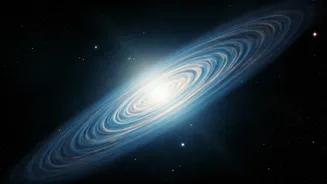
The story of dark matter begins with a simple observation that didn't add up. In the 1970s, astronomer Vera Rubin was studying how galaxies spin. She expected stars on the outer edges to move slower than stars near the center, just like planets farther
from the sun orbit more slowly. But that's not what she found. The outer stars were moving just as fast as the inner ones. This would be like watching a merry-go-round where the horses on the edge are somehow keeping pace with the ones near the middle. For that to happen without the whole thing flying apart, there has to be a lot more mass—and therefore more gravity—holding it all together. But we can't see this extra mass. It doesn't shine, reflect, or block light. It's a ghost in the galactic machine. This invisible stuff was dubbed “dark matter.”
Cosmic Magnifying Glasses
If spinning galaxies were the only clue, some might have dismissed it. But then came the second major piece of evidence: gravitational lensing. Einstein’s theory of relativity tells us that massive objects bend the fabric of spacetime, causing light to curve as it passes by. Astronomers see this all the time. When we look at a distant galaxy, its light is sometimes distorted, magnified, or even duplicated into multiple images by the gravity of a galaxy cluster sitting between it and us. The problem is, when scientists calculate the mass of all the visible stars and gas in the foreground cluster, it’s not nearly enough to create the level of distortion they observe. The lensing effect is far too strong. The only way to explain the discrepancy is to assume there's a huge, invisible halo of dark matter in the cluster, adding its gravitational pull to bend the light.
The Usual Suspects
For decades, the leading suspect for what dark matter might be was a hypothetical particle called a WIMP, or Weakly Interacting Massive Particle. The theory was elegant. WIMPs would be heavy particles that, as the name implies, barely interact with normal matter. They’d be floating all around us, and through us, without us ever noticing. They fit theoretical models of the early universe perfectly, and their properties could explain the cosmic structures we see today. Physicists were so confident about WIMPs that they spent billions of dollars building incredibly sensitive detectors to find them. These experiments are often built a mile underground in old mines to shield them from cosmic rays and other background radiation, hoping to catch the faint signal of a single WIMP bumping into an atomic nucleus.
A Search That Keeps Coming Up Empty
This is where the “guessing” part of the headline comes in. After years of searching, these ultra-sensitive experiments have found… nothing. Not a single, unambiguous WIMP. The detectors have become so powerful that they have now ruled out most of the simplest and most-predicted versions of the WIMP theory. It’s like building the world’s most sophisticated metal detector to find a specific lost key, scanning the entire park, and finding nothing. You start to wonder if you’re looking for the right key. This lack of evidence has thrown the field into a state of creative turmoil. Scientists are now considering other, more exotic candidates, like ultralight particles called axions, or even the possibility that dark matter isn't a particle at all, but a sign that our understanding of gravity is fundamentally wrong.