



Why Water Is the Grand Prize
On Earth, wherever we find water, we find life. From the boiling hydrothermal vents on the ocean floor to the frozen deserts of Antarctica, life has proven remarkably adept at thriving in the presence of H2O. This isn't a coincidence. Water is often called
the "universal solvent" because its unique chemical properties allow it to dissolve more substances than any other liquid. This ability is crucial for transporting nutrients, facilitating chemical reactions, and supporting the complex cellular machinery that defines life as we know it. While scientists are open to the possibility of life based on other chemistries—perhaps using liquid methane or ammonia—water remains the most promising and familiar starting point. It’s abundant in the universe and stable across a wide range of temperatures. So, when astronomers point their telescopes toward a distant world, the first question they often ask isn’t “Is anyone there?” but rather, “Is there any water?”
Searching Our Cosmic Backyard
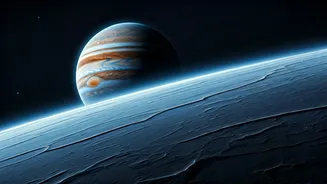
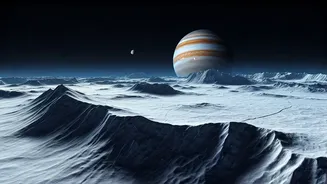
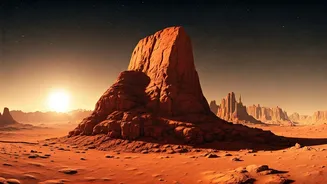
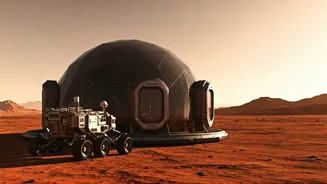
The hunt for water isn't just happening in distant star systems; some of the most exciting targets are right here in our own solar system. Mars, our rusty neighbor, has long been a prime suspect. Rovers like Perseverance and Curiosity have confirmed that the Red Planet was once a water world, with ancient river deltas and lakebeds etched into its surface. While liquid water can't exist on its surface today due to the thin atmosphere, vast quantities are locked away as ice in its polar caps and potentially as briny, slushy aquifers underground. Even more tantalizing are the icy moons orbiting our gas giants. Jupiter's moon Europa and Saturn's moon Enceladus are believed to hide vast, global oceans of liquid salt water beneath their frozen shells. We have direct evidence from Enceladus, where NASA's Cassini spacecraft flew through massive plumes of water vapor erupting from cracks in its icy crust. These plumes contained not just water, but also organic molecules and salts—the basic building blocks for life. NASA's upcoming Europa Clipper mission is designed specifically to investigate whether Europa’s hidden ocean has the potential to support life.
Peering into Distant Worlds
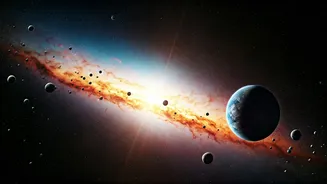
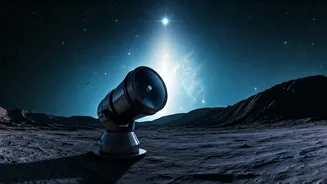
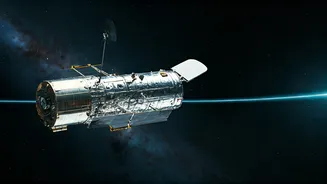
Thanks to powerful instruments like the James Webb Space Telescope (JWST), the search has gone interstellar. Scientists are now capable of studying the atmospheres of exoplanets—planets orbiting other stars—hundreds or even thousands of light-years away. The primary method is called transit spectroscopy. When an exoplanet passes in front of its star from our point of view, a tiny fraction of the starlight filters through the planet's atmosphere. By analyzing this light with a prism-like instrument, scientists can see which wavelengths were absorbed. Different molecules absorb different colors of light, creating a unique chemical fingerprint. Water vapor leaves a very distinct signature. JWST has already detected definitive evidence of water vapor in the atmospheres of several exoplanets, from scorching hot gas giants to smaller, rocky worlds. The goal is to find a planet in the "habitable zone"—the orbital sweet spot where temperatures are just right for liquid water to exist on the surface—and then detect the telltale sign of H2O in its atmosphere.
What Happens If We Find It?
Finding liquid water, especially an entire ocean on a moon like Europa, would be one of the most profound discoveries in human history. It wouldn't be proof of life, but it would transform the question from a theoretical possibility into a concrete scientific target. The next step would be to send a probe capable of drilling through the ice or analyzing plume samples for biosignatures—chemical traces that could only be produced by living organisms. Even detecting water vapor on a rocky, Earth-sized exoplanet in the habitable zone would be a monumental achievement. It would tell us that the ingredients for life as we know it are not unique to our solar system. It would mean that out of the billions of planets in our galaxy alone, countless worlds might have the right conditions for life to begin. The discovery wouldn't just be a scientific data point; it would reshape our understanding of our place in the universe.