


What Exactly Is a Moon Transit?
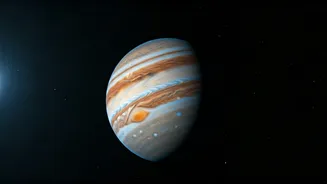
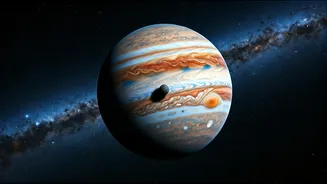
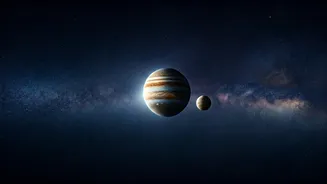
Think of it like a mini-eclipse, but on another world. A moon transit happens when one of Jupiter’s moons passes directly between the planet and Earth. From our perspective, we see the moon as a tiny disk crossing the face of the giant planet. Often,
what’s even more dramatic and easier to spot is the moon’s shadow—a small, dark, inky-black dot—gliding across Jupiter’s colorful cloud bands. Watching one of these shadows crawl across the planet in real time is an unforgettable experience. It’s a direct, visible reminder that you’re observing a dynamic, three-dimensional solar system, not just a static picture.
Meet the Galilean Moons
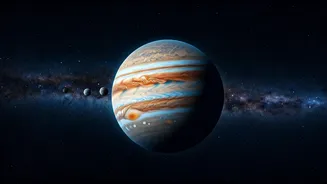
The stars of this show are Jupiter’s four largest moons, discovered by Galileo Galilei in 1610. Their discovery was a profound moment in science, proving that not everything in the heavens orbited the Earth. Get to know the cast: * **Io:** The innermost of the four, Io is a volcanic nightmare world, the most geologically active object in our solar system. It zips around Jupiter in less than two days, so its transits are frequent. * **Europa:** A smooth, ice-covered world hiding a potential subsurface ocean, Europa is a top candidate in the search for extraterrestrial life. * **Ganymede:** The largest moon in the entire solar system—bigger than the planet Mercury. Its transit and shadow are noticeably larger and easier to track. * **Callisto:** The outermost and most heavily cratered of the group, Callisto is a battered, ancient world. Its transits are less frequent due to its wider, slower orbit.
The Right Gear (It's Simpler Than You Think)
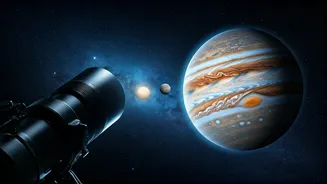
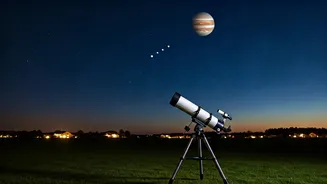
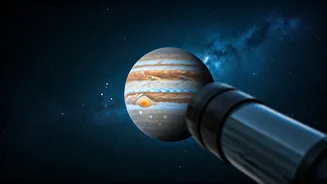
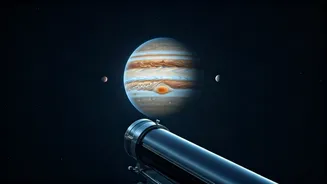
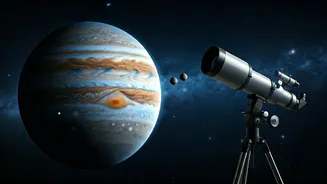
The phrase “simple telescope” isn't just marketing. While you can spot the four Galilean moons themselves with a good pair of binoculars—they’ll look like tiny stars huddled close to Jupiter—you’ll need a telescope to resolve the transits. A small refractor telescope (60-80mm aperture) or a modest reflector (4.5-inch mirror or larger) on a steady mount is more than enough. High magnification is key. You'll want to push your telescope to around 100x magnification or more to clearly separate the moon’s shadow from the planet's own features, like its famous cloud belts. The most important factor isn't raw power, but stability and clear skies.
Finding Jupiter in the Night Sky
Fortunately, Jupiter is the opposite of shy. On nights when it’s visible, it’s almost always the brightest or second-brightest “star” in the sky (after Venus, which is usually only seen near sunrise or sunset). It shines with a steady, brilliant, silvery-white light and doesn't twinkle as much as distant stars. To find its exact location, a free smartphone app like Stellarium, SkyView, or Star Walk is your best friend. Just point your phone at the sky, and the app will identify Jupiter for you. It’s often found along the ecliptic, the same path the sun and moon follow across the sky.
How to See the Show
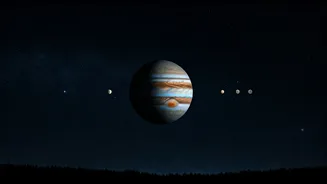
Once you have Jupiter in your eyepiece, start with low power to center it, then switch to a higher-magnification eyepiece. At first, you’ll see the planet as a small, bright disk, with its four moons lined up like tiny bodyguards. If a transit is in progress, look for a tiny, perfectly round black dot on the planet's face—that's a shadow. It will be much darker than any of Jupiter’s own storm features. If the moon itself is transiting, it can be harder to see, as its brightness can blend in with Jupiter's clouds. Patience is crucial. The movement is slow, so observe for 15-20 minutes to notice the shadow’s steady march across the planet. This slow, deliberate motion is what makes the experience so mesmerizing.
So, When Is 'Tonight'?
Because Jupiter and its moons are in constant motion, transits happen very frequently—sometimes multiple events are visible in a single week. The headline’s “tonight” is a recurring invitation. To get precise timings for your location, you don't need to be an expert. Websites like Sky & Telescope provide weekly or monthly almanacs that list all Jupiter moon events, including transits, occultations (when a moon disappears behind Jupiter), and eclipses (when a moon passes into Jupiter's shadow). Simply search for “Jupiter's moons transit times” to find a calendar tailored for observers. This will tell you exactly which moon is performing and when to be at your eyepiece.