




Welcome to the Abode of the Clouds
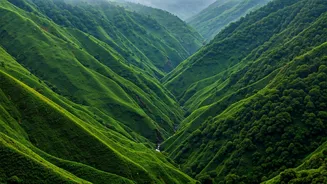
Tucked away in the northeastern corner of India, nestled between Bangladesh and the Brahmaputra River valley, lies a state whose name literally translates to “the abode of the clouds.” Meghalaya is a land of rolling emerald hills, deep gorges, and a culture
deeply intertwined with nature. For most of the year, it’s a beautiful, mist-laden region. But from June to September, it transforms into something else entirely. This is when the Indian monsoon arrives, and in Meghalaya, it doesn’t just rain—it performs. The state is home to Mawsynram and Cherrapunji, two towns that vie for the title of the wettest place on Earth, receiving over 450 inches of rain annually. To put that in perspective, Seattle gets about 38 inches. This isn't your average rainy day; it's a deluge of cinematic proportions that turns the entire landscape into a living, breathing water world.
When Rain Becomes a Spectacle
So what does the “wettest place on Earth” actually feel like? It’s an all-encompassing sensory experience. The drama begins with the sky, which shifts from blue to a brooding, dramatic grey. The air grows thick with the smell of petrichor—that earthy scent of rain on dry soil—mixed with the fragrance of wet foliage. Then the downpour starts, not as a gentle patter, but as a dense, roaring curtain of water. The sound is a constant, soothing hum, a white noise created by nature itself. This intense rainfall is caused by a phenomenon called orographic lift. As the moisture-laden clouds drift north from the Bay of Bengal, they hit the steep Khasi Hills, forcing them to rise rapidly, cool, and dump their incredible volume of water onto the plateau. Instead of being a reason to stay indoors, this biblical rainfall is the reason to come. It’s the force that gives life to everything that makes Meghalaya magical.
Waterfalls in Furious Overdrive
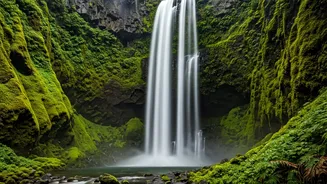
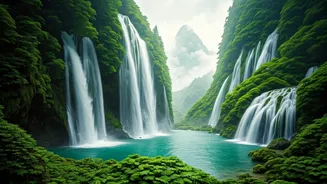
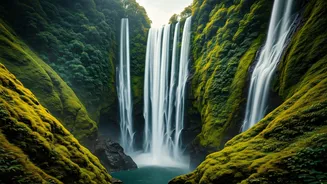
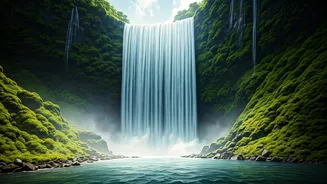
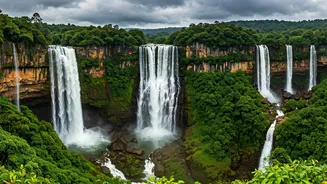
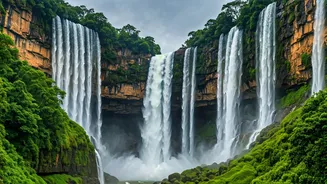
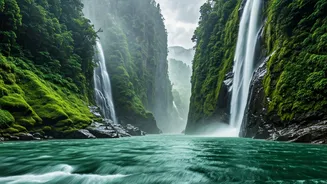
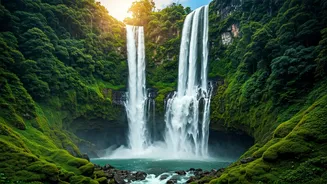
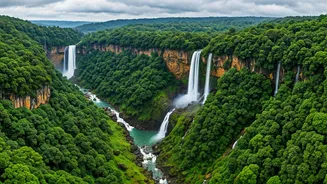
The most immediate and breathtaking result of the monsoon is the awakening of the waterfalls. During the dry season, many are mere trickles. But in the monsoon, they become raging torrents of immense power and beauty. The most famous is Nohkalikai Falls, which plunges over 1,100 feet from a verdant cliff into a turquoise pool below. During peak monsoon, it’s a thundering behemoth, its roar echoing through the valley and its spray creating a permanent cloud at its base. Nearby, the Nohsngithiang Falls, also known as the Seven Sisters Falls, presents a different kind of spectacle. A series of seven distinct streams of water cascade side-by-side down a wide limestone cliff face, creating a stunning panoramic vista. The sight of these falls, swollen and furious against a backdrop of dark clouds and impossibly green hills, is the very definition of monsoon drama.
Walking on Living Root Bridges
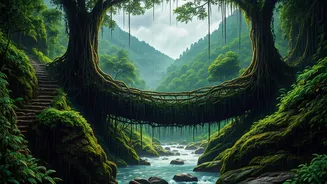
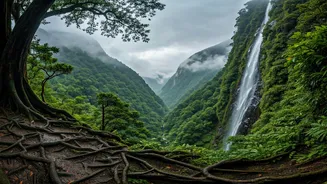
Perhaps the most enchanting and iconic feature of Meghalaya is its living root bridges. For centuries, the indigenous Khasi and Jaintia peoples have guided the aerial roots of the Ficus elastica tree across rivers and gorges, weaving them together over generations to form sturdy, living structures. These bridges are a marvel of bio-engineering, growing stronger over time as the roots thicken. During the monsoon, they are at their most mystical. Shrouded in mist, covered in slick green moss, and surrounded by the deafening sound of rushing water below, crossing one feels like stepping into a fantasy novel. The most famous of these is the Umshiang Double-Decker Root Bridge near Nongriat village, a two-tiered wonder that requires a multi-hour trek to reach but rewards every step with an unforgettable experience of human ingenuity working in perfect harmony with nature.