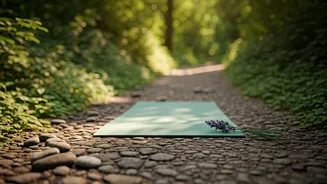









What Exactly Is Walking Yoga?
Walking yoga, also known as mindful walking or walking meditation, isn't about striking a warrior pose in the middle of the sidewalk. Instead, it’s the practice of bringing the core principles of yoga—awareness, breath, and intention—to the simple act of walking.
Where a typical walk might involve listening to a podcast, thinking about your to-do list, or simply getting from A to B, walking yoga invites you to be fully present in the experience. It’s about paying deliberate attention to the physical sensations of your body and the environment around you, moment by moment. Rooted in Buddhist traditions, particularly those taught by Zen Master Thich Nhat Hanh, the practice is less about physical exertion and more about mental and sensory awakening. It transforms a mundane activity into an opportunity for calm and connection.
The Benefits of Mindful Movement
Why bother turning your walk into a formal practice? The benefits lie in its accessibility and impact on mental well-being. For many, sitting meditation is a challenge; the mind races, and restlessness sets in. Walking yoga provides a gentle alternative that keeps the body engaged while calming the mind. Studies on mindfulness practices consistently point to reduced stress and anxiety, and mindful walking is no exception. By focusing on your breath and the physical feeling of your feet on the ground, you anchor yourself in the present moment, giving your brain a break from an endless loop of worries about the past and future. This practice can also improve your physical posture and body awareness. When you pay attention to how you walk, you might notice and correct slouching or an uneven gait. Finally, it fosters a deeper connection to your surroundings, helping you notice the small details of nature or your neighborhood that you’d otherwise miss.
Preparing for Your First Mindful Walk
Getting started is incredibly simple, which is a core part of its appeal. You don't need special gear, a yoga mat, or a quiet studio. All you need is a place to walk and a willingness to pay attention. For your first few practices, choose a location with minimal distractions—a quiet park, a garden, a track, or even a long hallway. A short, 10- to 15-minute walk is a perfect starting point. Wear comfortable shoes and clothing that won't distract you. The most important preparation is mental: set an intention to simply be present. Leave your phone in your pocket (or at home) and resist the urge to put in headphones. The goal is to tune in, not tune out.
A Simple Guide to Walking Yoga
Ready to try it? Follow these steps to guide your practice.
1. Stand and Settle: Before you take your first step, stand still for a moment. Feel your feet flat on the ground. Take two or three deep, slow breaths, and notice the sensation of the air entering and leaving your body.
2. Begin Walking Slowly: Start walking at a slower-than-usual, natural pace. You don't need to exaggerate the movement, just slow it down enough to notice it.
3. Focus on Your Feet: Bring your full attention to the soles of your feet. Notice the sensation of lifting one foot, moving it through the air, and placing it back down. Feel the heel connecting with the ground, then the ball of the foot, then the toes. Observe this cycle with each step: lift, move, place. Notice the subtle shifts in pressure and balance.
4. Coordinate with Your Breath: Once you’re comfortable focusing on your feet, begin to coordinate your steps with your breath. For example, you might take three steps for every inhalation and three steps for every exhalation. Find a rhythm that feels natural and unforced. This linkage of breath and movement is a classic yogic technique.
5. Expand Your Awareness: After a few minutes, gently expand your awareness to include other physical sensations. Notice the gentle swing of your arms, the feeling of the air on your skin, or the movement of your clothing.
6. Observe Without Judgment: Finally, open your awareness to the world around you. Notice the sights, sounds, and smells without labeling them as “good” or “bad.” Simply observe a bird singing, the color of the leaves, or the feeling of the sun. If your mind wanders to your to-do list (which it will), gently and without criticism, guide your attention back to the sensation of walking.