







The Scent of the Season
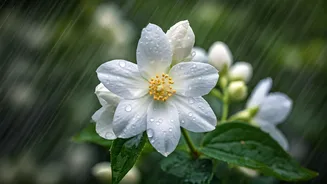
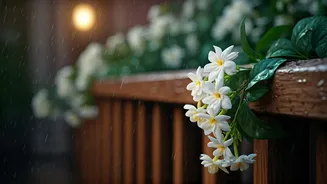
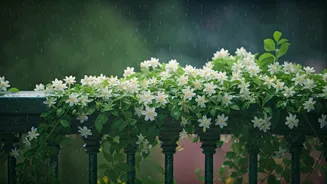
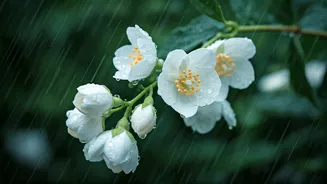
For much of the year, a jasmine vine can be an unassuming background player in a garden—a tangle of green leaves, perhaps dotted with small, tightly-closed buds. It’s lovely, but quiet. Then the weather turns. The sky darkens, the humidity skyrockets,
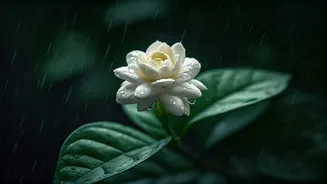
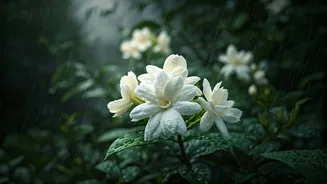
and the first fat drops of monsoon rain finally break a long, hot spell. This is when the transformation happens. As night falls, the jasmine flowers unfurl and release a fragrance so potent it seems to colonize the air itself. It drifts through open windows, hangs in courtyards, and perfumes entire neighborhoods. This isn't just a background floral note; it’s an announcement. The season has a new protagonist, and its presence is impossible to ignore.
The Science of the Atmosphere
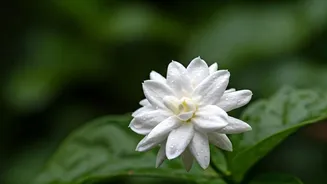
This dramatic entrance isn't pure poetry; it’s backed by simple atmospheric science. Many popular jasmine varieties, like *Jasminum sambac*—known as Mogra in India or Pikake in Hawaii—are crepuscular, meaning they release their most intense fragrance at dusk and into the night. They do this to attract nocturnal pollinators like moths. The scent itself is composed of volatile organic compounds. In dry air, these molecules dissipate quickly. But the super-saturated humidity of monsoon season works like a scent amplifier. The water vapor in the air slows the dispersal of the fragrance molecules, allowing them to hang in the air for longer and travel farther. The air becomes a thick, fragrant soup. Your nose isn’t imagining it: the jasmine really *is* more powerful, its presence made richer and more expansive by the very air you’re breathing. It’s the perfect storm of botany and meteorology.
A Deep Cultural Connection
In places where monsoons are a way of life, particularly across South and Southeast Asia, the scent of jasmine is inextricably linked to the season. It’s more than just a pleasant smell; it’s a powerful sensory cue loaded with cultural meaning. The flower is a fixture of daily ritual and celebration. Women weave fragrant strands of Mogra into their hair. Garlands are offered at temples, draped on car dashboards for good luck, or sold by vendors at traffic lights, their scent temporarily overpowering the city's exhaust fumes. The smell evokes feelings of romance, nostalgia, devotion, and the profound relief that comes with the cooling rains. When the monsoon amplifies that scent, it amplifies all the memories and emotions attached to it. The flower’s annual glow-up isn’t just a natural event; it’s a cultural one.
The Ultimate Glow-Up
This brings us back to “main character energy.” The term describes a moment of stepping into the spotlight with unshakeable confidence, becoming the focal point of the narrative. For those few months of rain, the humble jasmine vine does exactly that. It’s not just part of the scenery; it *is* the scenery. Its fragrance defines the evening, dictates the mood, and becomes the central sensory detail of the season. It doesn't ask for your attention; it commands it. The jasmine’s performance is a reminder that the most powerful forces aren’t always the loudest or the brightest. Sometimes, it’s a quiet vine that has been waiting patiently for the right conditions to completely and utterly take over.