





First Off, What Is a Quasar?
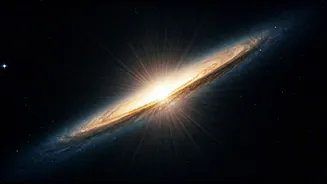
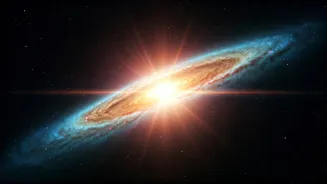
Let's clear one thing up: a quasar isn't a star, even though its name is short for "quasi-stellar radio source." Think of it less as an object and more as an event. At the heart of some very distant, young galaxies sits a supermassive black hole, millions
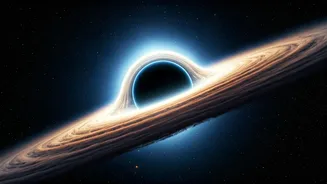
or even billions of times the mass of our sun. As this gravitational monster pulls in surrounding gas and dust, the material heats up to incredible temperatures, forming a brilliant, swirling disk. This accretion disk shines with the light of trillions of stars, creating a beacon so bright it can be seen across the entire observable universe. In essence, a quasar is the spectacularly messy and luminous process of a giant black hole having a meal. It's the brightest thing in the cosmic zip code, and it acts as a lighthouse shining from the distant past.
A Time Machine to the Cosmic Dawn
The headline's "850 million years old" can be a bit confusing. It doesn't mean the quasar itself lived for that long. Instead, it refers to a concept called "lookback time." Because light travels at a finite speed, when we look at objects that are very far away, we're seeing them as they were in the past. In this case, the light from this quasar has traveled for over 12 billion years to reach us. The discovery means astronomers have spotted this object as it existed just 850 million years after the Big Bang. To put that in perspective, the universe is currently about 13.8 billion years old. Finding this quasar is like finding a photograph from the universe’s early childhood—a time known as the 'Cosmic Dawn,' when the first stars and galaxies were just beginning to light up the darkness.
The 'Impossible' Black Hole Problem
Here’s why this discovery is so staggering for scientists at MIT and around the world. Finding a fully formed, massive quasar this early in the universe’s timeline is like finding a skyscraper built just a few years after the invention of bricks. Our current models suggest that black holes start small and grow over billions of years by consuming matter and merging with other black holes. But this ancient quasar is already powered by a behemoth black hole. How did it get so big, so fast? Its existence challenges our fundamental understanding of black hole formation. It suggests that perhaps the 'seeds' of the first black holes were much larger than we thought, or that they grew through some undiscovered, ultra-efficient process in the dense, gas-rich environment of the early cosmos. This single object poses a question that could rewrite a chapter of cosmic history.
How They Found This Ghostly Light
You don't just stumble upon a 13-billion-year-old beacon of light. Finding these objects requires a coordinated effort using some of the most powerful telescopes on and off the planet. Astronomers first scan huge swaths of the sky using survey telescopes. When they spot a candidate—an object with the right color signature to suggest it's extremely distant—they turn to more powerful instruments, like the James Webb Space Telescope or massive ground-based observatories in places like Chile or Hawaii. These telescopes can perform spectroscopy, a technique that breaks the object's light down into its constituent colors. This light-fingerprint not only confirms the object is a quasar but also reveals its distance (and thus its age) by measuring how much its light has been stretched, or 'redshifted,' by the expansion of the universe over billions of years.