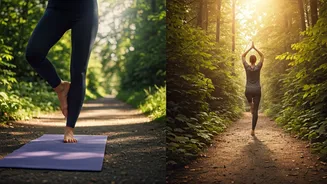








What Exactly Is Walking Yoga?
Don't picture yourself attempting a tree pose in the middle of a busy sidewalk. Walking yoga isn't about performing complex postures during a stroll. Instead, it’s the practice of bringing the core principles of yoga—mindfulness, breath awareness, and
intentional movement—into the simple act of walking. Think of it as a moving meditation. Instead of just getting from point A to point B, you focus on the rhythm of your steps, the sensation of your feet on the ground, and the cadence of your breath. It transforms a mundane activity into a restorative practice for both mind and body, requiring no special equipment, expensive studio memberships, or pretzel-like flexibility.
The Benefits of Gentle Movement
The beauty of walking yoga lies in its accessibility. It's a low-impact exercise that’s gentle on the joints, making it suitable for nearly all fitness levels and ages. The primary benefit is profound stress reduction. By synchronizing breath with movement and focusing on the present moment, you naturally activate the body's relaxation response, lowering cortisol levels and calming a racing mind. This mindful approach helps short-circuit the cycle of anxious thoughts that often accompanies a busy day. Physically, it improves posture, enhances balance, and promotes better circulation. It’s a holistic practice that delivers mental clarity and physical benefits without the risk of burnout or injury associated with more intense forms of exercise.
How to Start Your First Practice
Getting started is as simple as stepping outside. You don't need an hour; even 10-15 minutes can make a difference. 1. **Find a quiet place:** Choose a park, a quiet neighborhood street, or a nature trail where you can walk without too many distractions. 2. **Set an intention:** Before you start, take a moment to stand still. Decide what you want to get out of your walk. Is it to release stress? To find clarity? Just to enjoy the fresh air? 3. **Warm-up:** Do a few simple stretches. Gently roll your shoulders, neck, and ankles. Take three deep, cleansing breaths, inhaling through your nose and exhaling through your mouth. 4. **Start walking:** Begin at a natural, comfortable pace. Now, bring your awareness to your body. Notice your posture. Are your shoulders relaxed? Is your spine tall? Let your arms swing freely.
Simple Techniques to Try on Your Walk
Once you're moving, you can incorporate simple mindfulness techniques to deepen the practice. The easiest one is breath-step coordination. Try inhaling for four steps, then exhaling for four steps. Find a rhythm that feels natural and isn't forced. This simple count gives your mind a single, calming task to focus on. You can also practice sensory awareness. Devote one minute to noticing everything you see without judgment—the color of the leaves, the shape of the clouds. Then, spend the next minute focusing only on what you hear—the birds, the distant traffic, the sound of your own footsteps. This pulls you firmly into the present moment. If you feel comfortable, you can pause during your walk at a bench or stable surface to do a simple standing stretch, like a quad stretch or a gentle forward fold, before continuing on your way.