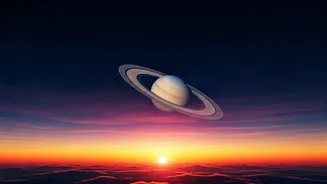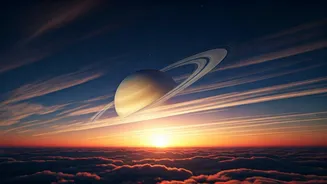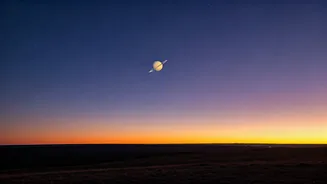



Why You Should Look Now
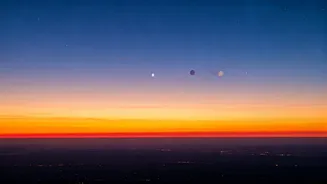
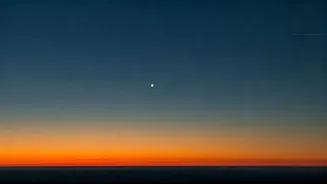
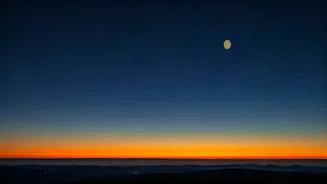
While you don’t need a once-in-a-lifetime cosmic event to see Saturn, certain times of the year offer a far better view. The planet is currently in a prime position for morning skygazers. This is thanks to its orbital dance with Earth. As we swing by
Saturn on our inside track around the sun, the distance between our two worlds shrinks, making the gas giant appear brighter and larger in our sky. For a few months every year, it rises in the late night or early morning, climbing high enough before sunrise to clear trees and buildings. This period gives amateur astronomers and the simply curious a fantastic window to spot the famous ringed planet without needing professional equipment. It’s a chance to see a whole other world with your own eyes, a pale-yellow dot that represents a colossal planet nearly 800 million miles away.
Your Step-by-Step Viewing Guide
You don’t need a star chart or a fancy app, though they can help. The key is knowing when and where to look. 1. **Check the Time:** The best viewing window is in the final hours before dawn. Set an alarm for about 90 minutes before your local sunrise. This gives you a dark sky, but with Saturn high enough to be seen clearly. 2. **Find Your Direction:** Look towards the east or southeast. Saturn will be among the brightest objects in that part of the sky. 3. **Know What to Look For:** Unlike stars, which twinkle, planets shine with a steady, constant light. Scan for a bright, unwavering “star” that has a distinct yellowish or pale-gold hue. Its light is serene, not sparkly. If you see an object that fits this description and isn't moving like an airplane, you've likely found it. Over several nights, you'll notice it slowly drifts against the background of more distant, fixed stars.
The Science Behind That Yellow Glow
That signature color isn’t just a trick of the light; it’s a direct result of Saturn’s alien atmosphere. The planet is a gas giant, composed mostly of hydrogen and helium, but its upper atmosphere contains ammonia ice crystals. These crystals are fantastic at reflecting sunlight. When the sun’s light hits Saturn’s upper cloud decks, the ammonia crystals scatter the light in a way that gives the planet its characteristic pale-yellow tint. It's the same principle as clouds on Earth appearing white because they scatter all colors of light, but Saturn’s specific chemical makeup favors this creamy, yellowish shade. So when you see that color, you're not just seeing a point of light—you're seeing the chemical fingerprint of a world hundreds of millions of miles away.
Naked Eye, Binoculars, or Telescope?
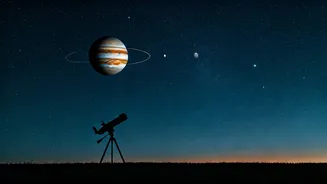
Your experience will vary depending on your gear, but every level offers a reward. * **Naked Eye:** To the unaided eye, Saturn will appear as a bright, yellowish, star-like object. The main thrill here is the simple act of identification—knowing that dot of light is the legendary ringed planet. It’s a moment of connection to the cosmos. * **Binoculars:** A standard pair of binoculars (7x50 or 10x50 are great) will make a huge difference. While you won't be able to resolve the rings, you will see that Saturn is not a perfect point. It will appear as a tiny, slightly elongated disk. This is because the binoculars are beginning to separate the planet from its rings, even if they can’t show them distinctly. You might also spot Saturn’s largest moon, Titan, as a faint, star-like companion nearby. * **Small Telescope:** This is where the magic happens. Even a modest beginner’s telescope with 50x magnification can reveal Saturn’s most famous feature: the rings. They will look like tiny “handles” or ears on either side of the planetary disk. It’s an unforgettable sight and one of the true showstoppers of backyard astronomy.