



The Promise of a Perfect View
There’s an implicit contract we make with nature when visiting a place named “Sunset Point.” We expect a spectacle: a fiery orb dipping below a crisp horizon, painting a clear sky in strokes of orange, pink, and gold. So when you arrive at the rim of Bryce
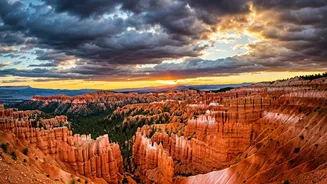
Canyon National Park, looking down into its silent city of bizarre, coral-colored rock spires called hoodoos, a ceiling of gray clouds can feel like a raw deal. The air is cool, the sun is nowhere to be seen, and the other tourists are starting to pack up their cameras, muttering about bad luck. But a few stick around. They’re the ones in the know. They aren’t looking at the horizon; they’re watching the clouds themselves. Because here, in this geological wonderland, a cloudy sky isn’t a curtain closing on the day’s performance. It’s the screen on which the real movie is about to be projected. The main event isn’t the sun disappearing, but what it does to the world in its final moments from beneath the stage.
Nature's Silver Screen
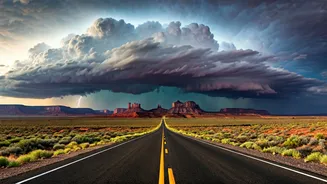
The magic trick is all about light and texture. On a clear day, sunset colors are created by a phenomenon called Rayleigh scattering. As the sun’s light travels through more of Earth’s atmosphere, shorter-wavelength blue and green light gets scattered away, leaving the longer-wavelength reds and oranges to reach our eyes. It’s beautiful, but it’s also a bit one-dimensional. Clouds change the game entirely. They are, in essence, a giant, textured movie screen hanging in the sky. When the sun sinks below the horizon, it’s no longer shining *on* the clouds, but *up into them*. This hidden light bounces and refracts off the countless water droplets and ice crystals, transforming a flat gray ceiling into a canvas of unimaginable depth and color. The undersides of the clouds catch fire with deep crimsons, hot magentas, and vibrant violets—hues you rarely see in a clear sky. The texture of the clouds creates pockets of shadow and intense light, giving the sky a dramatic, three-dimensional quality that feels, for lack of a better word, cinematic.
When Light Paints Stone
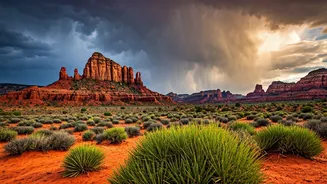
And it’s not just about the sky. That incredible, diffused light spills over the rim of the canyon and pours down into the amphitheater below. Bryce Canyon’s hoodoos, already otherworldly, become actors in this drama. The warm, indirect light makes their iron-rich reds and oranges glow as if lit from within. Every crease and crack in the ancient limestone is filled with soft shadow, accentuating their strange, beautiful forms. Instead of the harsh, direct light of a setting sun that creates long, dark shadows, the cloud-filtered light is gentle and encompassing. It wraps around the spires of the Silent City and Thor’s Hammer, making the whole landscape feel alive and breathing. This is the moment photographers dream of: when the sky and the land are in perfect, dramatic conversation. The cloudy sky doesn’t just put on a show; it directs the lighting for the entire scene, turning a static landscape into a dynamic, emotional tableau.
How to Catch the Show
If you’re planning a trip, don’t be discouraged by a cloudy forecast. In fact, hope for a day with mid-to-high-level clouds—not a complete, uniform washout, but a sky with some texture and breaks. Arrive at Sunset Point (or nearby Inspiration Point, for a slightly different angle) at least 30 minutes before the official sunset time. The biggest mistake people make is leaving the moment the sun is gone. The real show—the “cinema”—often begins 10 to 20 minutes *after* sunset, during a period called civil twilight. This is when the most intense colors ignite the clouds from below. Dress in layers, as the temperature on the rim at 8,000 feet drops quickly. Bring a tripod for your camera to handle the low light, but more importantly, give yourself permission to just put the phone down and watch. The performance is fleeting, and no photo can truly capture the feeling of being bathed in that impossible, otherworldly glow.