

The King We Know and Love
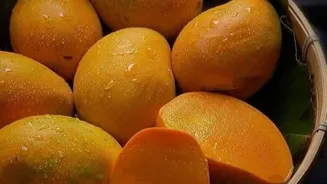
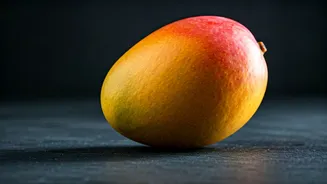
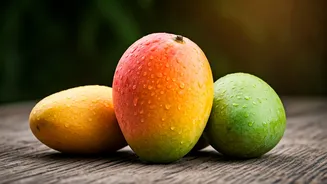
Let’s start with the reigning monarch: the Alphonso. Hailing from the western coastal regions of India, this is the mango that built the myth. With its saffron-hued, non-fibrous flesh, creamy texture, and an intense flavor that balances sugar and acid
perfectly, the Alphonso is often called the “King of Mangoes.” For years, it was the primary, and often only, Indian mango variety available for export, thanks to its relatively sturdy skin and world-class public relations. Its short season and high demand created a frenzy, cementing its status as the pinnacle of mango perfection in the minds of many global foodies. When you hear someone rhapsodize about the life-changing experience of eating a true Indian mango, they are almost certainly talking about an Alphonso.
Meet the Kesar, the Saffron-Scented Queen
If the Alphonso is king, the Kesar is its equally regal queen. Grown primarily in the state of Gujarat, the Kesar mango gets its name from its saffron-like color and intoxicating aroma. It’s slightly less sweet than the Alphonso, with a bright, tangy finish that many prefer. The skin is a duller green-yellow, often tricking newcomers into thinking it isn't ripe. But inside lies a brilliant orange pulp that’s perfect for making *aamras*, a traditional mango puree. The Kesar’s distinct personality is a perfect first step for anyone looking to understand that “Indian mango” is a category, not a single flavor profile. It's the mango that proves the kingdom has more than one ruler.
The Sweet, Fiberless Dasheri
Travel north to the mango belts of Uttar Pradesh, and you’ll find the beloved Dasheri. This is a mango with a history, traced back to a single 18th-century “mother tree” that still stands. Unlike the rounder Alphonso, the Dasheri is longer and more elegant in shape. Its main claim to fame is its absolutely fiberless, melt-in-your-mouth pulp. The flavor is pure, sugary sweetness with notes of peach and melon, making it a favorite for eating fresh. Because it’s thinner-skinned and more delicate, it hasn’t historically traveled as well as the Alphonso, but improved logistics are changing that. For those who prioritize pure, uncomplicated sweetness without a single stringy interruption, the Dasheri is a revelation.
The Uniquely Tangy Langra
For a walk on the wilder side, there’s the Langra. A specialty of Varanasi and the surrounding region, this mango is a true original. It’s known for retaining a greenish tint even when fully ripe and for a flavor profile that leans more towards tart and citrusy than purely sweet. A ripe Langra has a distinct, almost turpentine-like fragrance that connoisseurs cherish. The name, which translates to “lame,” is said to have come from the original farmer who cultivated it. Its complex, slightly acidic flavor makes it a polarizing but intensely loved variety in India. Finding one in the U.S. is still a treasure hunt, but it represents the incredible depth of the mango gene pool.
Why the Mango Map Is Expanding
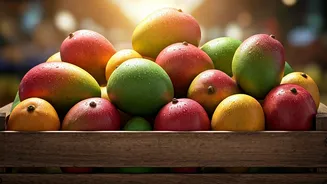
So why are we suddenly seeing these other names pop up in specialty grocery stores and online? It’s a combination of factors. First, improved irradiation and supply chain logistics have made it easier to import these more delicate varieties. Second, the growing Indian-American diaspora has created a built-in demand for the regional favorites they grew up with. Finally, American food culture has become more adventurous. We’re no longer satisfied with a single representative; we want to explore the nuances of tequila, coffee, and olive oil, and mangoes are the next delicious frontier. Retailers are realizing there’s a market for mangoes with a story, a specific terroir, and a unique flavor beyond the one-size-fits-all approach.