





Your Simple Pre-Dawn Viewing Guide
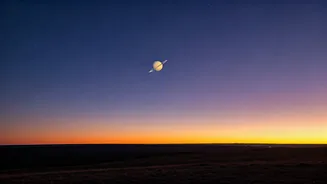
You don't need a fancy telescope or a degree in astrophysics to spot Saturn. You just need an alarm clock, a clear view of the eastern horizon, and about 15 minutes of patience. The best time to look is roughly 45 to 60 minutes before your local sunrise.
This is the sweet spot when the sky is dark enough to see planets and bright stars clearly, but the approaching dawn begins to silhouette the horizon. Head outside and face east or southeast. Let your eyes adjust to the darkness for at least five to ten minutes; you’ll be amazed at how much more you can see. Look for a moderately bright, steady point of light that isn’t twinkling furiously. That calm, golden-hued dot is your target: the sixth planet from the sun.
How to Know It's Saturn, Not a Star
The night sky is filled with points of light, so how do you pick out the right one? The easiest trick is the “twinkle test.” Stars, which are incredibly distant suns, have light that is easily disturbed by Earth’s atmosphere, causing them to twinkle or scintillate. Planets in our solar system, on the other hand, are much closer. Their light appears as a more solid, unwavering disk (even if it looks like a point to our eyes). Because of this, planets tend to shine with a steady, serene glow. When you scan the eastern sky, look for the object that seems to be holding still and shining calmly. Saturn will appear as a yellowish-white point of light, not as piercingly bright as Venus, but easily distinguishable from the surrounding stars in the constellation Aquarius, where it currently resides.
What You're Actually Looking At
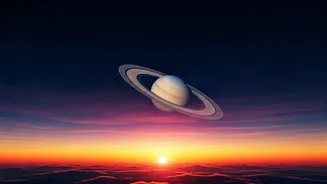
That small, steady point of light is a colossal world more than 880 million miles away. Saturn is a gas giant so large that you could fit 764 Earths inside it. While you won't see its famous rings with the naked eye, the light you’re seeing has traveled for over an hour across the vastness of space to reach your retina. The glow is sunlight, bouncing off the top of Saturn's hydrogen and helium clouds and traversing the solar system. Even a basic pair of binoculars can enhance the view, making the planet’s color more apparent and holding it even steadier in your field of vision. A small backyard telescope, however, will reveal the iconic rings—a truly breathtaking sight. But the simple act of identifying the planet without any aid is a rewarding experience in itself.
Use Your Phone as a Pocket Planetarium
If you're feeling unsure, technology can be your best friend. There are dozens of excellent and often free stargazing apps for your smartphone (such as Star Walk, SkyView, or Stellarium). These apps use your phone’s built-in GPS and compass to create an augmented-reality map of the sky. Simply download one, grant it location access, and point your phone at the eastern sky. The app will label the stars, constellations, and, most importantly, any planets in your view. It’s an incredibly helpful tool that takes all the guesswork out of your celestial scavenger hunt, confirming that the bright dot you’re admiring is indeed the majestic Lord of the Rings.