






What Exactly Is Walking Yoga?
Don’t worry, this doesn’t involve attempting a warrior pose on a busy sidewalk. Walking yoga is less about complex postures and more about infusing the simple, everyday act of walking with the core principles of yoga: conscious breathing, postural awareness,
and a mindful connection between body and mind. Think of it as upgrading your daily stroll into a practice of active restoration. Instead of walking on autopilot while listening to a podcast or mentally running through your to-do list, walking yoga asks you to be fully present. It draws inspiration from traditional walking meditation, a practice rooted in Buddhist traditions popularized by figures like Thich Nhat Hanh, and combines it with the physical alignment cues of Hatha yoga. The goal is to synchronize your steps with your breath and tune into the sensations of your body and the environment around you. It’s a low-impact activity that’s accessible to almost everyone, requiring no special equipment—just a willingness to slow down and pay attention.
The 'Moving Meditation' Advantage
The true power of walking yoga lies in its ability to quiet the mental chatter that often accompanies us throughout the day. In our hyper-connected world, even our exercise time can become another task to optimize and rush through. Walking yoga is the antidote to that mindset. By focusing on the rhythm of your own breath and the feeling of your feet on the ground, you anchor yourself in the present moment. This is the essence of a 'moving meditation.' This practice can help reduce stress and anxiety by calming the nervous system. The synchronized breathwork, known in yoga as pranayama, helps regulate your heart rate and signals to your brain that it’s safe to relax. Unlike sitting meditation, which can be challenging for those with busy minds, the gentle, repetitive motion of walking gives your mind just enough to focus on, preventing it from wandering into anxious thought loops. It cultivates a sense of peace and clarity that can stay with you long after your walk is over, all while providing the well-known cardiovascular benefits of walking.
Key Principles to Practice
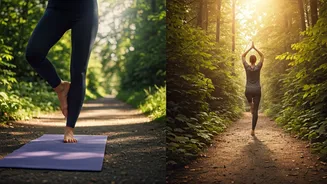
Integrating walking yoga into your routine is simple. It’s not about perfection, but about intention. Here are the core principles to focus on during your next walk: 1. **Conscious Breathing:** Start by noticing your breath without trying to change it. Then, begin to link it to your steps. A common pattern is to inhale for three or four steps, and then exhale for three or four steps. Find a rhythm that feels natural and calming, not forced. The consistency of this pattern is what creates the meditative state. 2. **Mindful Footsteps:** Pay close attention to the physical sensation of walking. Feel your heel connect with the ground, the sole of your foot rolling forward, and the push-off from your toes. Notice the transfer of weight from one foot to the other. This practice of kinesthetic awareness grounds you in your body. 3. **Yogic Posture:** Walk with the alignment of Tadasana (Mountain Pose). Stand tall, lengthen your spine, and relax your shoulders down and away from your ears. Keep your chin parallel to the ground and your gaze soft, looking a few feet ahead. Avoid hunching or looking down at your phone. This posture promotes better breathing and projects a quiet confidence. 4. **Sensory Engagement:** Open your awareness to the world around you without judgment. Notice the color of the sky, the sound of birds, the feeling of the breeze on your skin, or the smell of rain on the pavement. Acknowledge these sensations and then gently return your focus to your breath and steps.
Your First 15-Minute Session
Ready to try it? Find a quiet path, a park, or even a calm neighborhood block where you won’t be overly distracted. Leave your headphones behind for the first few sessions. * **Minutes 1-3 (Warm-Up):** Begin walking at a natural pace. For these first few minutes, just focus on arriving. Let go of whatever you were doing before and bring your attention to your body. Notice your posture and the rhythm of your breath as it is. * **Minutes 4-12 (The Practice):** Start to synchronize your breath and steps. Try inhaling for four steps and exhaling for four steps. Focus on maintaining a tall, relaxed posture. When your mind wanders—and it will—gently and without judgment, guide your attention back to the sensation of your feet on the ground and the count of your breath. * **Minutes 13-15 (Cool-Down):** Let go of the structured breathing pattern and walk at a natural pace again. Use these last few moments to simply notice how you feel. Are you calmer? More centered? Carry this feeling of mindful awareness with you into the rest of your day.