






The Promise of a Blank Canvas
We’ve all been there. You’ve hiked to the vista, claimed a spot on the scenic overlook, or simply walked to the end of the pier. You came for the main event: the sunset. The expectation, fueled by a billion picture-postcards, is for a perfect, blazing
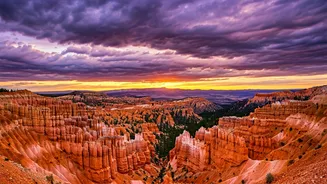
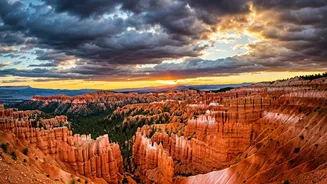
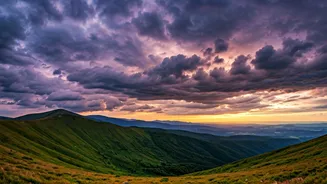
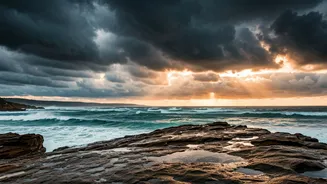
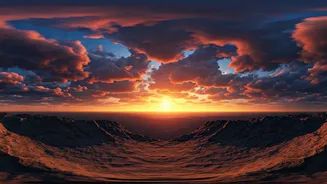
orb sinking into a clear, crisp horizon. So when the clouds gather in the late afternoon, a sense of anticlimax settles in. Phones are checked. Jackets are zipped. People start murmuring about beating the traffic. This is the moment of mass delusion. The belief that a clear sky provides the best sunset is one of the great, enduring myths of amateur meteorology. A cloudless sunset is, to be blunt, often boring. The sun goes down, the light fades, and the show is over. It’s a single, predictable act. But a cloudy sky? That’s not a ruined view; it’s a blank canvas waiting for a masterpiece. The clouds are not an obstruction; they are the screen on which the day’s final, most dramatic light will be projected.
The Science of a Spectacular Show
To understand why clouds are a sunset’s best friend, you need a quick lesson in light. As the sun sinks lower, its light travels through more of Earth’s atmosphere. This journey scatters the shorter, cooler blue and green wavelengths, leaving the longer, warmer reds, oranges, and pinks to reach our eyes. This is called Rayleigh scattering, and it’s why even a clear sunset has some color.
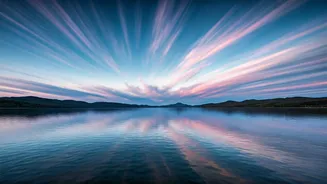
But clouds introduce a new, dynamic element. They are composed of water droplets or ice crystals that catch and reflect this warm, filtered light. Think of them as millions of tiny, floating movie screens. High and mid-level clouds, like the wispy cirrus or dappled altocumulus, are the best performers. They are high enough to catch the sun’s rays long after it has dipped below the horizon from your perspective. The bottoms of these clouds ignite in impossible shades of magenta and gold, turning the entire dome of the sky into an immersive art installation.
Waiting for the Afterglow
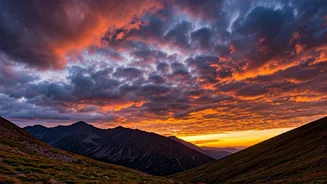
The rookie mistake is leaving as soon as the sun disappears. The connoisseur knows that this is merely the intermission. The most breathtaking color often occurs 10 to 20 minutes *after* the sun has set, a phenomenon known as the afterglow, or “civil twilight.” During this window, the sun is at the perfect angle below the horizon to illuminate the underside of the clouds with its most intensely filtered, deep-red light.
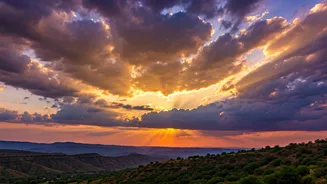
This is when the sky can feel like it’s on fire. The clouds create texture, depth, and drama. You might see “crepuscular rays,” which are beams of sunlight streaming through gaps in the clouds, fanning out across the sky like searchlights. The colors shift second by second, from fiery orange to soft rose, then to deep violet before finally fading to indigo. It’s a slow, evolving performance, one that rewards patience. While the clear-sky crowd is already in their cars, you’re witnessing a second, more intimate sunset that only the clouds could deliver.
How to Read the Sky
Not all clouds are created equal. A low, thick, uniform blanket of stratus clouds that socks in the horizon will likely kill the show. What you’re looking for is a sky with some structure and variety. A mix of high, wispy clouds and broken, mid-level formations is ideal. Look for gaps near the western horizon where the sun can dip below the cloud deck and light everything up from underneath.
Learning to read the afternoon sky becomes a satisfying skill. You start to see a partly cloudy forecast not as a threat, but as an opportunity. You begin to notice the texture of the clouds, their height, and their movement. You stop looking for perfection and start looking for potential. And when you’re the only one left on the beach, watching a purple-and-gold spectacle unfold across the heavens, you’ll understand the secret: the sun is just the lamp, but the clouds are the shade that makes the light beautiful.