




Why You Should Look Now
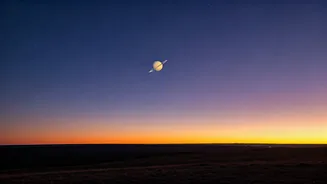
Saturn, the famous ringed planet, is currently in a prime position for viewing. As Earth continues its journey around the sun, our path brings us closer to Saturn in its own orbit, making it appear brighter and larger in our sky. This period leading up
to its “opposition” in early September—when Earth passes directly between Saturn and the sun—is the best time of year to see it. The planet rises in the east during the late evening hours and remains visible until dawn, climbing higher in the sky as the night progresses. You don’t need a fancy observatory or a degree in astrophysics; all you need is a clear night and a moment to look up.
Your Simple Stargazing Guide
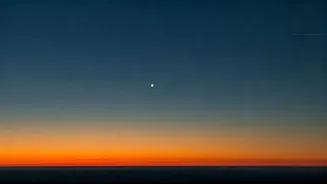
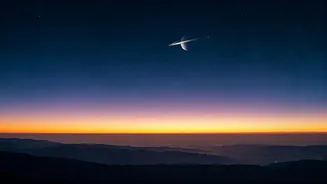
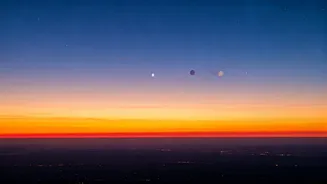
Finding Saturn is easier than you might think. First, check your local forecast for a clear night. An hour or two before sunrise is often the sweet spot, as the planet will have climbed higher above the horizon, away from the haze and atmospheric distortion that can make celestial objects shimmer. Face east and look for a steady, non-twinkling point of light. Stars twinkle because their light is distorted by our atmosphere, but planets, being much closer, shine with a more constant glow. Saturn will appear as a moderately bright, yellowish-white “star.” If you have a stargazing app on your phone, like SkyView or Star Walk, it can point you in the exact direction, removing all the guesswork. But there's a certain magic in finding it on your own, a bright, serene beacon in the pre-dawn sky.
Naked Eye, Binoculars, or Telescope?
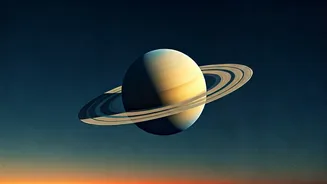
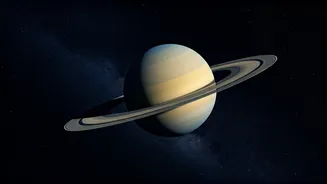
Your viewing experience will depend on the equipment you have, but even the simplest approach is rewarding. With just your naked eye, you'll see Saturn as a bright, steady point of light, distinct from the surrounding stars. Its soft, yellowish hue is often quite noticeable. If you grab a pair of binoculars, the view gets even better. While you won’t see the rings as a distinct structure, you may notice that the “star” looks slightly elongated or oval-shaped. This is the combined light of the planet and its magnificent ring system. You might even be able to spot its largest moon, Titan, as a tiny pinprick of light very close to the planet. For the main event, however, a small backyard telescope is required. Even a modest telescope with 30x magnification will transform that point of light into a tiny, perfect sphere encircled by its iconic rings—a truly breathtaking sight that has captivated observers for centuries.
What Makes Saturn a Superstar
Jupiter may be the king of the planets, but Saturn is the jewel of the solar system. Its rings are what make it an astronomical icon. They stretch up to 175,000 miles across but are, in most places, astonishingly thin—perhaps only 30 to 300 feet thick. They aren’t solid; they’re made of countless individual particles of ice and rock, ranging in size from dust grains to small houses, all orbiting the planet. From our vantage point nearly a billion miles away, they coalesce into the beautiful, shimmering bands we see through a telescope. Scientists are still debating the rings' age and origin, but one thing is certain: they make Saturn an object of unparalleled beauty. Seeing them for yourself, even as a tiny, distant image, is a powerful reminder of the scale and wonder of our cosmic neighborhood.