







An Unassuming Exterior
The journey to the Dilwara Temples prepares you for a grand entrance. You ascend Mount Abu, the only hill station in a state known for its deserts, winding through lush greenery. But when you arrive, there is no towering facade or dramatic gate. The temple
complex, built between the 11th and 13th centuries, presents a surprisingly humble face to the world—a simple, high-walled enclosure of aging white stone. It feels more like a quiet monastery than a world-renowned architectural wonder. This intentional modesty is deeply rooted in Jain philosophy, which values humility and an inner, rather than outer, focus. The temples don't shout their significance; they whisper it to those who step inside. It’s a powerful lesson that the most profound beauty often lies hidden from plain sight, waiting to be discovered rather than announced.
A Universe Carved from Marble
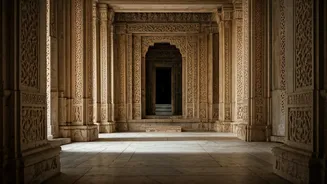
Crossing the threshold is like stepping into another dimension. The sun-drenched simplicity of the exterior vanishes, replaced by an explosion of intricate, luminous white marble. Every surface—pillars, archways, and ceilings—is covered in carvings of breathtaking complexity. In the two most famous temples, the Vimal Vasahi and the Luna Vasahi, the artistry reaches its zenith. The ceilings bloom into fantastic, lace-like domes, with central pendants that appear to hang weightlessly, carved from a single block of stone. One dome in the Luna Vasahi temple features 71 figures of Jain Tirthankaras in dancing poses, while another contains a chandelier-like central carving so fine it seems translucent. The sheer detail is overwhelming. You see gods and goddesses, celestial musicians, processions of elephants, and geometric patterns so perfect they feel computer-generated. It is a testament not just to skill, but to an almost superhuman level of patience and devotion.
The Sound of Quiet Contemplation
This is where the crowd, or lack thereof, becomes the most important part of the experience. On a busy day, the Dilwara Temples are a marvel to be seen. On a quiet day, they are a wonder to be felt. Without the jostle of tour groups and the constant hum of chatter, the space transforms. The silence allows you to hear the subtle echo of your own footsteps on the cool marble floors. It gives you the time to trace the line of a single carving with your eyes, to notice the way light filters through the stone, and to truly appreciate the scale of the human effort on display. Each of these carvings was made by hand, a painstaking process that took generations of artisans. In the quiet, you can almost feel the presence of those long-ago craftsmen. The peace isn't just an absence of noise; it's an active presence that allows the temple's spiritual and artistic energy to fill the space. It’s in these moments you understand that this wasn't just built as a landmark, but as a sanctuary for contemplation.
Art as an Act of Faith
To a Western visitor, the sheer decorative density might seem like pure aesthetic indulgence. But in the context of Jainism, it is anything but. The temples were commissioned by wealthy ministers of the Solanki dynasty, not as monuments to their own power, but as acts of devotion and a means of earning spiritual merit. Jain principles, such as non-violence (Ahimsa) and non-possessiveness (Aparigraha), are woven into the site's fabric. The incredible detail is meant to inspire a sense of awe and encourage the visitor to contemplate the divine. It’s a physical manifestation of a spiritual ideal, where the perfection of the art reflects the pursuit of a perfect, enlightened state. The anonymous artisans who spent their lives carving these stones did so as a form of worship, and that devotional energy is still palpable nearly a thousand years later, especially when you have the space and quiet to receive it.