





A Clockwork Solar System in Miniature
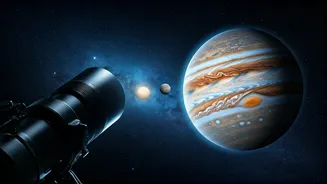
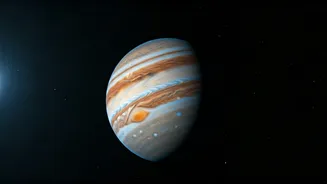
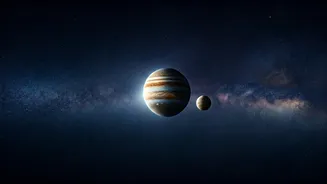
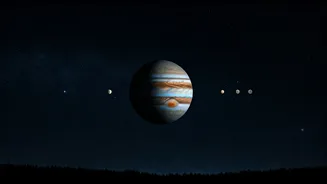
When Galileo Galilei first pointed his telescope at Jupiter in 1610, he discovered four points of light orbiting the gas giant. Now named Io, Europa, Ganymede, and Callisto, these Galilean moons are worlds in their own right, and they circle Jupiter with
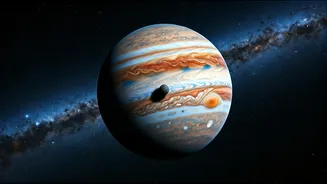
a beautiful, clockwork predictability. A transit is what happens when one of these moons passes directly between Jupiter and the Sun, casting its tiny shadow onto the planet’s swirling cloud tops. What you see from Earth is a small, dark dot slowly crawling across the face of Jupiter. It’s a stunningly direct and personal way to witness the mechanics of our solar system in real time. It’s not just an astronomical event; it’s a connection to a cosmic dance that has been unfolding for billions of years, visible to you on any clear night when the timing is right.
Your Essential Backyard Toolkit
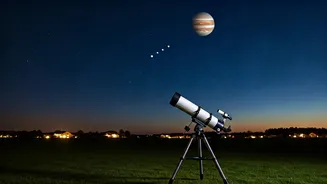
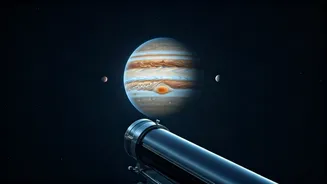
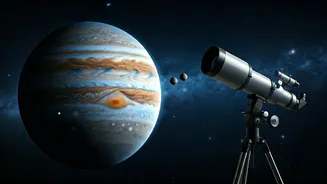
While you can’t see this phenomenon with the naked eye, you don’t need a professional observatory either. The key is magnification. A good pair of astronomy binoculars (typically 10x50 or 15x70) mounted on a tripod for stability is enough to resolve the four Galilean moons as distinct points of light around Jupiter. You’ll be able to watch them change position from night to night. However, to clearly see the shadow of a moon during a transit, you’ll want a telescope. Don't be intimidated; a decent beginner's reflecting or refracting telescope with an aperture of at least 4 inches (around 100mm) will do the trick. More important than raw power is optical quality and a sturdy mount. A shaky view is a frustrating view. A basic telescope kit can provide breathtaking glimpses of Jupiter’s bands and the slow, deliberate journey of a moon's shadow.
Finding Your Celestial Timetable
The moons orbit Jupiter on different schedules, so transits happen frequently but not every night. The secret to catching one is knowing when to look. Fortunately, we live in a golden age of digital astronomy tools. Free planetarium software like Stellarium (for desktop) or mobile apps like SkySafari, Star Walk, or even NASA’s own app can show you the current positions of the moons. More advanced tools and websites, like Sky & Telescope's online Almanac, provide precise timetables specifically for Jupiter’s moon transits, shadow transits, and occultations (when a moon disappears behind the planet). These resources will tell you the exact date and time (usually in Universal Time, so be sure to convert to your local time zone) that a shadow will begin its journey across Jupiter's disk. Plan your viewing session around these predictions for a guaranteed show.
Your Step-by-Step Observation Guide
Once you have your date and time, the process is straightforward. First, give your eyes about 15-20 minutes to adjust to the darkness, away from bright lights or phone screens. Next, set up your telescope or tripod-mounted binoculars and locate Jupiter—it’s one of the brightest objects in the night sky, so you can't miss it. Start with a low-power eyepiece to easily find and center the planet in your view. Once you have it, switch to a higher-magnification eyepiece to get a closer look. At first, you’ll see the planet and its moons as bright dots. As the transit begins, focus on Jupiter's cloud bands. You are looking for a tiny, perfectly black, and sharp-edged dot to appear on one side of the planet. Over the next hour or two, you’ll be able to watch it drift silently across the face of the gas giant. It’s a subtle, patient, and deeply rewarding experience.