




The 240,000-Mile Pharmacy Problem
Long-duration space missions, like those planned for NASA's Artemis program, present a unique medical dilemma. Astronauts face a barrage of health risks, including bone density loss, muscle atrophy, and a suppressed immune system from microgravity and cosmic
radiation. While we can pack medications, they come with significant drawbacks. Traditional pharmaceuticals have expiration dates, and their effectiveness can degrade when exposed to the high-radiation environment of deep space. Packing enough of every potential medicine for a multi-year Mars mission would be a logistical nightmare, taking up precious weight and volume on the spacecraft. What happens if an astronaut has a medical issue that wasn't anticipated, or if a specific drug supply runs out? A resupply mission isn't an option when home is a six-month journey away.
Enter the High-Tech Lettuce
Researchers at the University of California, Davis, are pioneering a solution that sounds like science fiction: turning plants into tiny, living medicine factories. The concept, known as “biopharming,” involves genetically engineering common plants to produce specific therapeutic proteins. The team, led by chemical engineer Karen McDonald, has focused on a species of lettuce. They've successfully modified it to produce a human parathyroid hormone (PTH), a drug used to treat osteoporosis. In space, this could directly combat the severe bone density loss that astronauts experience. The same technology could be used to create plants that produce granulocyte-colony stimulating factor (G-CSF), a protein that helps stimulate the production of white blood cells, bolstering an astronaut’s compromised immune system. The idea is to have a variety of seeds, each coded to produce a different, vital medicine on demand.
Just Add Water (and Light)
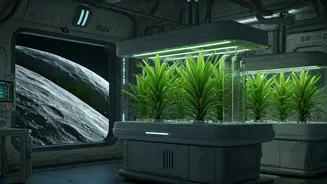
The proposed system is elegantly simple. Astronauts wouldn't need a sprawling hydroponic farm. Instead, they would use a compact, contained growth chamber. They would carry a small vial containing thousands of transgenic seeds, which are lightweight and stable for years. When a specific medicine is needed, they would plant the appropriate seeds. In about a month, the lettuce would mature. The astronauts would then harvest the leaves, crush them to extract the plant's fluids, and use a simple purification process to isolate the target protein. The final product could be administered as a dose-controlled medication. This “just-in-time” manufacturing model means medicines are produced only when needed, ensuring maximum freshness and potency while minimizing waste and payload mass. It transforms medicine from a static, degrading cargo item into a renewable resource.
From Lab Bench to Lunar Base
While the science is promising, this technology isn't quite ready for the next rocket launch. Researchers still have several hurdles to clear. They need to demonstrate that the plants can grow successfully in the microgravity and radiation conditions of space. They also need to increase the concentration of the therapeutic proteins in the plants to ensure astronauts can get a proper medical dose from a manageable amount of lettuce. Finally, the extraction and purification process needs to be perfected into a simple, reliable kit that an astronaut—who may not be a trained biologist—can operate flawlessly millions of miles from Earth. Despite these challenges, the initial results are a significant leap forward, proving the underlying concept is sound and offering a tangible path toward medical self-sufficiency in space.