


The Journey to Quiet
The journey to Hemis Monastery is a pilgrimage in itself. Flying into Leh, the capital of Ladakh, you are immediately struck by the landscape. This is the “rooftop of the world,” a starkly beautiful desert over 11,000 feet above sea level, framed by the snow-dusted
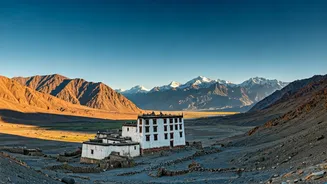
peaks of the Himalayas. The air is thin and crisp, demanding you slow down. From Leh, it's an hour-long drive along winding roads that follow the turquoise Indus River, carving through a dramatic, almost lunar, terrain. The world outside your window is a panorama of barren mountains painted in shades of ochre, purple, and brown. You leave the small-town bustle of Leh behind, and with every mile, the sounds of civilization recede, replaced by the whisper of the wind whistling through deep gorges. The monastery is not visible from the main road; it reveals itself only after you turn into a narrow side valley, hidden away as if to protect its tranquility.
A Fortress of Solitude
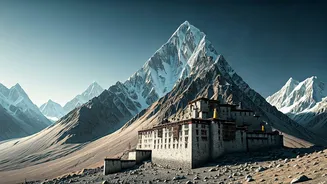
Founded in the 17th century, Hemis Gompa is the largest and wealthiest monastery in Ladakh, belonging to the Drukpa Kagyu school of Tibetan Buddhism. Yet for all its importance, its first impression is one of humility and harmony with its surroundings. The complex is a striking collection of whitewashed, stone-and-timber buildings that seem to grow organically from the mountainside. Brightly colored murals and intricate woodwork adorn the main prayer halls, their vibrant reds, golds, and blues standing in stunning contrast to the muted landscape. A giant courtyard, which explodes with color and sound during the annual Hemis Festival, sits empty and serene for most ofthe year. As you walk through its stone-paved paths, past giant prayer wheels turned by the hands of devout pilgrims and resident monks, you feel a palpable sense of history and devotion that has soaked into the very walls.
The Sound of Silence
The headline's promise of “absolute” silence is, of course, a human perception. What you find at Hemis is not a void, but a different kind of soundscape. The dominant noise of modern life—engines, electronics, overlapping conversations—is completely gone. In its place, you notice things you’d otherwise miss. You hear the rhythmic flapping of hundreds of prayer flags strung across the gorge, carrying their mantras on the wind. You hear the gravel crunching under your own feet, a sound usually lost in the daily din. From one of the prayer halls, you might hear the low, resonant hum of monks chanting, a sound that seems to vibrate in your very bones. You hear the caw of a raven echoing off the cliff faces. This is the sound of a place at peace. It's a silence so profound that it feels active, a presence that encourages introspection and calms the busiest of minds. It’s the kind of quiet that allows you to hear your own thoughts, or better yet, to stop thinking altogether.
Life Within the Walls
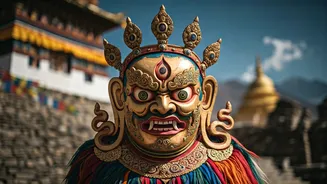
Hemis is no museum. It is a living, breathing center of spiritual learning, home to a community of monks, from young boys in training to learned elders. Their crimson robes provide a splash of color against the monastery’s stoic architecture. Their days are structured around prayer, study, and the maintenance of the complex. While visitors are welcomed, the atmosphere remains one of reverence and routine. The monastery also houses a magnificent collection of thangkas (Tibetan silk paintings), ancient statues, and religious artifacts, including a famous one that is only unrolled for public viewing once every 12 years. This continuity of tradition underscores the monastery’s role as a guardian of a culture that has weathered centuries of change. The annual Hemis Festival, dedicated to the Buddhist guru Padmasambhava, offers a rare glimpse of the monastery in full, vibrant celebration, with masked dances and ritual music that temporarily replace the deep silence with joyous sound, making the return to quiet all the more powerful.