




The Unique Horror of a Wet Backpack
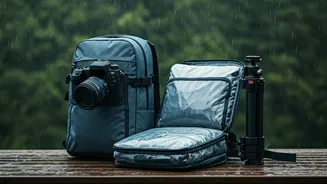
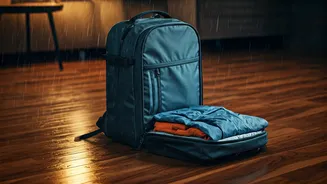
Let’s be honest about the specific dread a rain-soaked backpack inspires. It’s not just about getting wet. It’s about the violation of your personal, portable ecosystem. Your bag is your daily command center, and water is the enemy of order. A downpour
turns your carefully packed world into a damp, chaotic mess. The bottom of your notebook now has that wavy, bloated look. A stray charging cable might be sitting in a puddle you can’t see. And then there's the ultimate fear: the silent, creeping dread that moisture has found its way into your laptop or tablet. A “water-resistant” backpack often just means it delays the inevitable. Seams leak, zippers aren’t taped, and a determined drizzle will always find a way in. This is the moment most people start frantically searching for expensive, fully waterproof bags. But that’s a costly overcorrection for a problem that can be solved with a smarter internal strategy. The goal isn't just to build a better fortress; it's to have a better evacuation plan.
Enter the Pouch: Your Bag’s Defensive Line
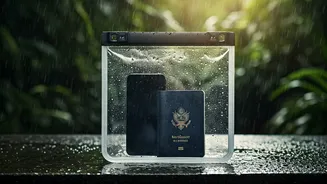
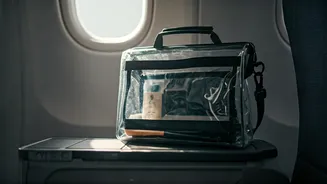
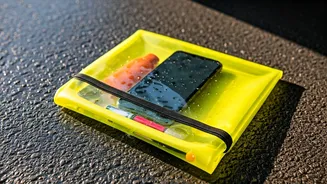
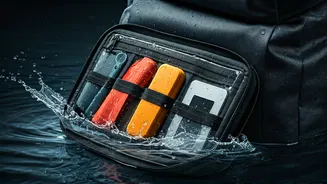
This is where the humble pouch organizer makes its case for Most Valuable Player. We’re not talking about the flimsy, freebie cosmetic bags you get with a purchase. We’re talking about dedicated, structured zip pouches—the kind designed for tech, travel, or general organization. Think of them less as simple containers and more as modular, semi-rigid lifeboats for your most important items. Their primary job in a dry bag is to tame the clutter of cables, chargers, pens, and lip balms. But on a rainy day, their role transforms from organization to protection. By compartmentalizing your gear, you create multiple, smaller zones of defense within the larger, more vulnerable space of your backpack. The pouch becomes the first and most important barrier between a leaking water bottle or a compromised seam and your expensive electronics. It’s defense in depth, for your dongles.
It’s About Containment, Not Just Resistance
Here's the argument that elevates pouches from “nice to have” to “non-negotiable.” Their true MVP power isn’t just keeping rain *out* of the pouch, but keeping potential disasters *in*. Has a pen ever exploded in your bag? Has a travel-size bottle of hand sanitizer ever leaked? Without pouches, that small mess becomes a bag-wide catastrophe, coating everything in a sticky, inky film. A good pouch contains the failure. The leaky lotion is confined to a single, washable space. The pen ink ruins a $20 organizer, not a $1,500 laptop and a signed copy of a book. This principle of containment is even more crucial in a wet environment. If a little water *does* get into your backpack, it’s not free to roam. It’s firewalled off from your most sensitive items, which are safely zipped away. The pouch doesn’t need to be 100% waterproof to be 100% effective; it just needs to be a barrier.
The Ultimate 'Grab-and-Go' Security
In a true worst-case scenario—a complete downpour, a bag dropped in a puddle, a catastrophic zipper failure—the pouch system provides the ultimate escape hatch. You don’t need to save the whole ship. You just need to grab the essentials. With a well-organized system, you have one pouch for your tech (phone, power bank, cables), one for your wallet and keys, and maybe another for personal items. If things go sideways, you can open your backpack, grab one or two critical pouches, and abandon the rest. This modularity turns a frantic, fumbling search for your phone into a single, decisive action. Your MVP isn't just playing defense; it’s ready to make the game-winning play when everything is on the line. It offers a sense of control and security that no single backpack compartment can match.