

A Rebellion Against Rigid Lines
For the better part of a decade, the dominant interior aesthetic was one of crisp, clean, and often severe lines. Think of the stark floating shelves, minimalist metal frames, and the unwavering geometry of mid-century modern reproductions. This look
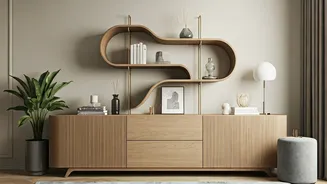
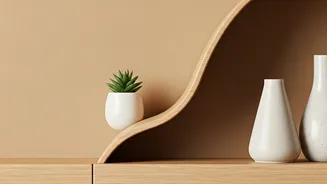
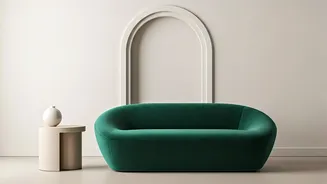
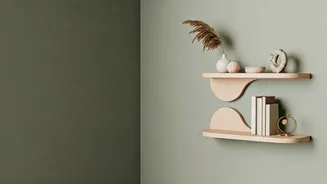
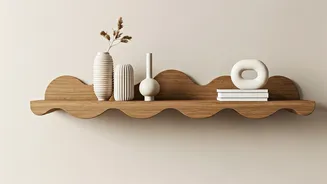
communicated order, efficiency, and a kind of sophisticated restraint. But after years of living in these carefully curated, right-angled boxes—many of which doubled as our entire worlds during the pandemic—a collective desire for something softer has emerged. The scalloped shelf, with its undulating, wave-like edges, is a direct and delightful rebellion against that rigidity. It’s an organic form in a world of manufactured straightness. These gentle curves disrupt the monotony of a flat wall, introducing a sense of movement and playfulness that feels both refreshing and deeply human. It’s less about stark efficiency and more about creating a space that feels comforting, approachable, and emotionally resonant.
The Psychology of the Curve
There’s a reason we’re drawn to these shapes. Studies in design psychology have long suggested that humans have an innate preference for curved forms over sharp, angular ones. Curves are perceived as safer, friendlier, and more natural—they mimic forms found in nature, from rolling hills to gentle waves. Sharp angles, conversely, can subconsciously register as threatening or harsh. In the context of the home, which we increasingly view as a sanctuary from a chaotic world, filling our spaces with softer shapes makes perfect sense. The scallop is the perfect embodiment of this impulse. It’s not an aggressive or demanding design; it’s a gentle, welcoming gesture. Placing one in a living room is a subtle way of saying, “This is a space for relaxation and ease, not for sharp-edged formality.”
A Nod to Nostalgia and Craft
While the trend feels fresh, the scallop motif is steeped in history. It brings to mind the glamorous flourishes of Art Deco architecture, the playful details of 80s Memphis Design, and the charming trim on antique furniture. This historical echo gives the trend a sense of depth and timelessness. It doesn't feel like a completely disposable fad because it’s rooted in classic design language. Furthermore, the scalloped edge implies a level of craftsmanship. Unlike a simple plank of wood, creating a perfectly undulating edge requires more detail and intention. In an era of mass-produced, flat-pack furniture, a piece with this kind of considered detail feels more special and bespoke. It’s a small signal of appreciation for design and craft, which in itself has become a form of status. It’s not about the price tag, but about a curated eye for detail.
The New Definition of Status
This is where the “status symbol” aspect truly comes into play, but it’s a new kind of status. It isn’t about ostentatious wealth or displaying the most expensive object. Instead, the scalloped shelf signifies *taste status*. It shows you’re in tune with the current cultural and aesthetic zeitgeist. It suggests you have moved beyond the now-ubiquitous minimalist look into something more personal and forward-thinking. Owning one signals that you value whimsy, personality, and a bit of joy in your decor. In a social media-driven world, where homes are curated for the camera, the scalloped shelf is an “if you know, you know” item. It’s visually distinct and instantly recognizable to fellow design enthusiasts, earning points for style and originality rather than for pure monetary value. It’s the perfect backdrop for a curated collection of books, ceramics, and personal treasures—a stage for your own unique story.