







The Universe in Panoramic View
First, let's get one thing straight: the Roman Telescope isn't just a bigger, better version of the James Webb or Hubble. It's a completely different tool for a different job. Think of Hubble and Webb as powerful telephoto lenses, designed to zoom in for breathtakingly
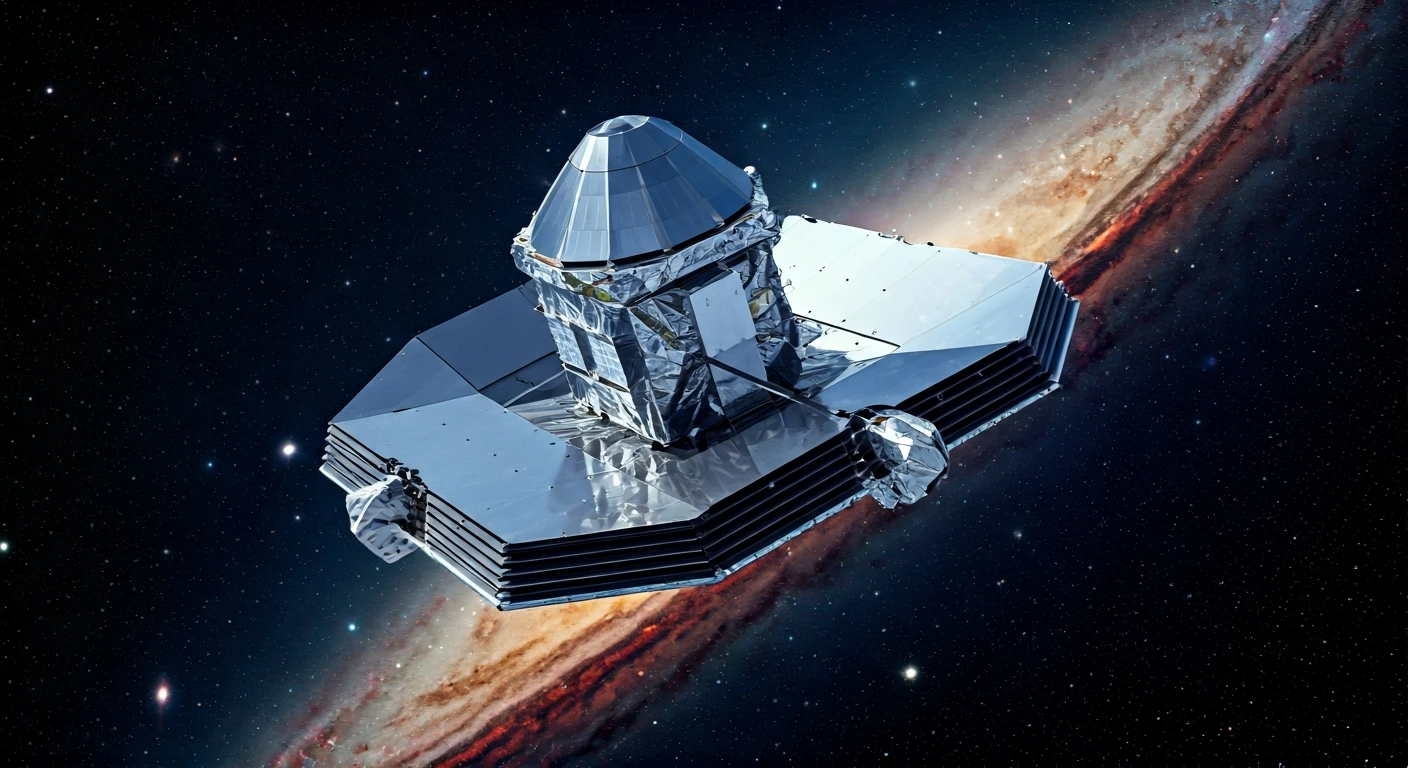
detailed portraits of a single galaxy or nebula. They are masters of the cosmic close-up. The Roman Telescope, scheduled to launch by May 2027, is the opposite. It’s the panoramic camera. Its primary mirror is the same size as Hubble's (2.4 meters), but its instrumentation is revolutionary. Roman's Wide Field Instrument will give it a field of view 100 times larger than Hubble's. In a single snapshot, it will capture a patch of sky that would take Hubble hundreds of pictures to assemble. This isn't about seeing one thing in glorious detail; it's about seeing everything, everywhere, all at once. This unique ability to conduct massive, sweeping surveys of the cosmos is what makes Roman so powerful and why NASA is betting billions on its success.
Hunting the Ghost in the Machine: Dark Energy
So what do you do with a camera that can photograph the entire universe? You use it to hunt for things you can't see. Roman's primary mission is to tackle one of the biggest mysteries in all of science: dark energy. Scientists know the universe is expanding, but in the late 1990s, they discovered that this expansion is inexplicably speeding up. The mysterious force driving this acceleration was dubbed 'dark energy,' and it's believed to make up nearly 70% of the entire universe. The problem is, we have no idea what it is. Roman will attack this problem by creating the largest 3D maps of the universe ever made. By imaging hundreds of millions of galaxies and measuring their distances and distributions, astronomers can trace the history of the universe's expansion with unprecedented precision. By observing how cosmic structures have grown and evolved over billions of years, Roman will help scientists test theories about dark energy, potentially revealing its nature or proving our current understanding of gravity is incomplete. It's a high-stakes attempt to write the next chapter of cosmology.
A Galactic Census of Alien Worlds
While one camera is mapping the cosmos, another on Roman will be conducting a different kind of survey closer to home. The telescope's second major objective is to perform a galactic census of exoplanets. While NASA's Kepler and TESS missions have found thousands of planets by watching for the slight dimming of a star as a planet passes in front of it (the 'transit method'), Roman will primarily use a different technique called gravitational microlensing. Microlensing occurs when a massive object, like a star or planet, passes in front of a more distant star. The foreground object's gravity acts like a lens, briefly magnifying the light from the background star. It's a powerful method that is sensitive to planets far from their host star and even 'rogue' planets that wander the galaxy without a star to orbit at all. Roman is expected to find thousands of new worlds this way, from rocky planets smaller than Mars to gas giants larger than Jupiter. The goal isn't just to find more planets, but to get a statistical understanding of their demographics. How common are Earth-like systems? Are rogue planets the norm? Roman will give us the data to find out.
Why It's A 'Big Bet'
The term 'bet' is appropriate. With a projected cost of around $4.3 billion, the Roman Telescope is a massive investment. The project, formerly known as WFIRST (Wide-Field Infrared Survey Telescope), has faced its share of budgetary battles and was even recommended for cancellation at one point. Its survival is a testament to the scientific community's belief in its transformative potential. The telescope's hardware has a fascinating backstory. Its 2.4-meter primary mirror was originally built for a classified spy satellite program by the National Reconnaissance Office. When the NRO no longer needed two of these high-tech mirrors, they were donated to NASA. This gift saved the project an enormous amount of time and money, but designing a whole new observatory around a pre-existing mirror still presents unique engineering challenges. It's a bet that NASA can leverage this Cold War-era relic into a 21st-century discovery machine, delivering groundbreaking science that complements, rather than competes with, the James Webb Space Telescope.