








Why Your Cat Needs to Climb
In the wild, cats are both predator and prey. Climbing provides a critical advantage for survival. For an indoor cat, these instincts don't just disappear. Providing vertical space, often called 'environmental enrichment,' taps directly into their hardwired
needs. A high perch offers a secure vantage point from which to survey their territory (your living room) without fear of being ambushed by the dog, the vacuum cleaner, or a toddler. It gives them a sense of control and safety, which can significantly reduce stress-related behaviors like over-grooming or scratching furniture. Furthermore, navigating a wall-mounted course provides essential physical exercise, keeping your cat lean, agile, and mentally stimulated. A bored cat is often a destructive cat; a climbing cat is a fulfilled one.
Planning Your Feline Superhighway
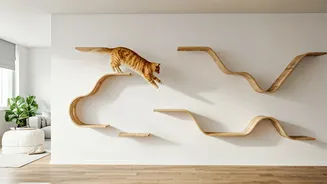
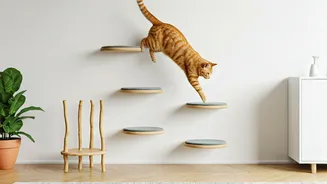
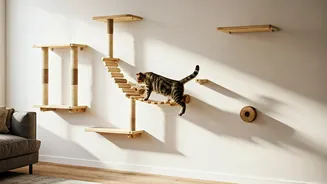
Before you start drilling, grab a pencil and paper (or some painter’s tape). The best cat walls feel like a natural extension of your cat's movement. Think about creating a logical path with multiple routes. Where does your cat like to hang out? Consider starting the path near a favorite napping spot or a window. The goal is to create an intuitive circuit, not just a series of disconnected shelves. Use painter's tape on the wall to map out potential shelf locations. Can your cat realistically make the jump from one perch to the next? A good rule of thumb is no more than a foot or two horizontally and vertically between steps, depending on your cat’s age and athletic ability. Think about flow: a path could lead up to a high-up 'destination' shelf, a cozy cat hammock, or across the top of a doorway.
Choosing the Right Components
A great cat wall offers a variety of textures and experiences. You can buy pre-made kits from pet supply companies or go the DIY route with hardware store materials. Shelves are the basic building block—simple pine boards, sanded and sealed, work perfectly. Cover some with carpet remnants or sisal fabric for grip and scratching. Add dedicated scratching surfaces, like vertical sisal-wrapped posts, to redirect that clawing instinct. Fabric hammocks offer a soft place to lounge, while enclosed cat cubbies provide a secure, den-like hideaway. Roped bridges add a fun, challenging element that tests your cat’s balance. The key is variety. Mix and match different elements to keep the path interesting and engaging.
Installation: Safety is Non-Negotiable
This is the most critical step. A poorly installed shelf can be a serious danger to your pet. Your number one tool is a stud finder. Do not rely on drywall anchors alone; they are not designed to hold the weight of a cat landing on them with force. Every shelf or bracket must be securely screwed into a wall stud. If your ideal layout doesn't align with your studs, you can mount a horizontal board (a ledger board) into the studs first, and then attach your shelves to that board. Always use screws and hardware rated for significantly more weight than your cat. Once installed, give each shelf a firm tug to ensure it’s completely stable. The surface of the shelves should be non-slip; if you're using painted wood, consider adding a carpet square or a non-toxic, grippy coating.
The Grand Unveiling and Training
Don't be surprised if your cat ignores your masterpiece at first. Cats are cautious creatures. The best way to introduce them to their new climbing wall is with positive reinforcement. Place their favorite treats or a sprinkle of catnip on the lower shelves to entice them to explore. Use a laser pointer or a wand toy to guide them up the path, turning it into a game. Never force your cat onto the shelves. Let them discover it at their own pace. Your patience will be rewarded when you finally see them confidently navigating the course or snoozing contentedly on the highest perch, masters of their new, elevated domain.