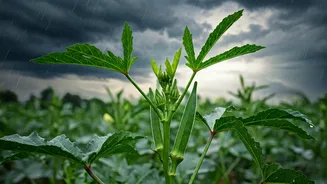









A Staple Crop Under Pressure
In the United States, okra is a regional favorite. In India, it's a national necessity. As one of the country's most widely consumed vegetables, bhindi is a source of essential nutrients and a crucial cash crop for millions of small-scale farmers. But
its success has always been tied to the whims of the weather, especially the annual monsoon season. While the rains are vital for agriculture, a changing climate is making them more erratic and intense. Longer dry spells are being punctuated by extreme downpours, creating a hostile environment for traditional okra varieties. These conditions not only risk flooding and physically damaging the plants but also create the perfect breeding ground for devastating diseases. The most notorious is the Yellow Vein Mosaic Virus, a pathogen spread by whiteflies that thrive in humid weather. The virus can stunt plant growth and drastically reduce yields, turning a potentially profitable harvest into a devastating loss for farmers.
Engineering a More Resilient Okra
In response, agricultural scientists across India are leading a concerted “monsoon-ready push.” This isn't about building tiny umbrellas for plants; it's a sophisticated effort in crop science. Researchers at institutions like the Indian Council of Agricultural Research (ICAR) have been developing and releasing new hybrid varieties of bhindi specifically bred for resilience. These new strains are the result of years of meticulous cross-breeding designed to produce a plant with multiple defensive traits. The primary goal has been to create varieties with strong genetic resistance to the Yellow Vein Mosaic Virus, effectively immunizing them against the monsoon’s biggest threat. Beyond disease resistance, these new versions are often higher-yielding and can better tolerate fluctuations in water availability, making them more robust in the face of unpredictable weather patterns. Some varieties are also bred to have a shorter cultivation cycle, allowing farmers to harvest their crop before the peak of monsoon-related problems.
From the Lab to the Land
Developing a super-okra is only half the battle; getting it into the hands of farmers is the critical next step. The “push” involves a multi-pronged strategy of distribution and education. Government agencies and agricultural universities are working to make these new, resilient seeds widely available and affordable. Demonstration farms are set up to show farmers, firsthand, the difference in yield and durability between the old and new varieties. Agricultural extension programs, which serve as a link between scientists and rural communities, play a vital role in teaching farmers the ideal cultivation practices for these new hybrids to maximize their potential. This initiative represents a practical, science-driven solution aimed at stabilizing a key part of India's food supply and protecting the livelihoods of its most vulnerable agricultural workers.
Why This Matters Beyond India
While the story of monsoon-ready bhindi is rooted in India, its implications are global. It serves as a powerful case study in climate adaptation for food systems everywhere, including in the United States. American farmers are also grappling with their own climate challenges, from historic droughts in the West to unprecedented flooding in the Midwest. The core problem is the same: how do we ensure our food supply remains stable when the weather we’ve relied on for generations is no longer reliable? The work being done on okra in India provides a blueprint. It highlights the crucial role of public investment in agricultural research and the importance of creating crops that are not just productive, but resilient. As extreme weather events become the new normal around the world, the future of food may depend on these small, localized innovations that prepare essential crops, one vegetable at a time, for a tougher, more unpredictable world.