





The New King: James Webb Space Telescope
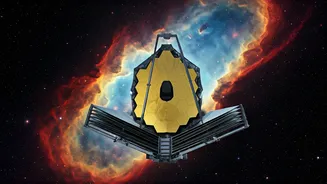
If power is the ability to see back to the dawn of time, the James Webb Space Telescope (JWST) is the undisputed champion. Launched on Christmas Day 2021, this $10 billion marvel is engineered to see the universe in infrared light. Why infrared? Because
as the universe expands, light from the very first stars and galaxies gets stretched out, shifting from visible light into the infrared spectrum. Webb’s massive, 6.5-meter, gold-coated beryllium mirror acts like a giant bucket, collecting this faint, ancient light. It orbits the sun a million miles from Earth, far from our planet's heat and light pollution, allowing it to capture images of cosmic nurseries and a baby universe with breathtaking clarity. It’s not just more powerful than Hubble; it’s seeing a universe Hubble physically couldn’t.
The Enduring Icon: Hubble Space Telescope
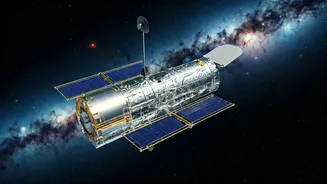
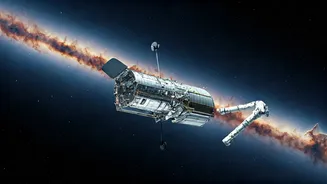
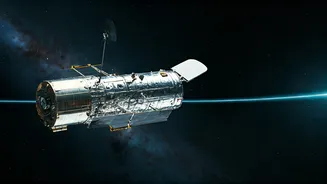
Before Webb, there was Hubble. Launched in 1990, the Hubble Space Telescope single-handedly changed our relationship with the cosmos. Its power lies not just in its 2.4-meter mirror, but in its location. Orbiting above the distorting effects of Earth's atmosphere, Hubble delivered razor-sharp images in visible and ultraviolet light that became instant cultural touchstones—the Pillars of Creation, the Hubble Deep Field. It proved the existence of supermassive black holes, helped determine the age of the universe, and captured stunning images of planets in our own solar system. While no longer the biggest or newest, Hubble’s three-decade legacy of discovery and its role in bringing astronomy into the public imagination make it one of the most impactful scientific instruments ever conceived.
The Power of Teamwork: The Very Large Telescope
Sometimes, power comes from collaboration. Located in the hyper-arid Atacama Desert of Chile, the European Southern Observatory’s Very Large Telescope (VLT) isn’t one telescope, but an array of four massive 8.2-meter telescopes. They can work independently, but their true power is unleashed when they work together. Using a technique called interferometry, the light from all four telescopes can be combined, giving them the resolving power of a single telescope with a mirror up to 200 meters in diameter. This allows astronomers to see incredibly fine details, like the surfaces of distant stars or the chaotic dance of matter around the supermassive black hole at the center of our own galaxy. The VLT is the undisputed king of ground-based optical astronomy, proving that on Earth, teamwork makes the cosmic dream work.
The Invisible Universe Viewer: ALMA
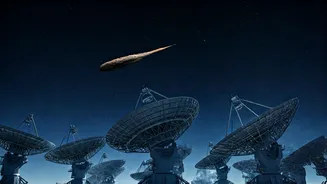
What if the most powerful telescope was one that sees light that’s invisible to our eyes? Meet the Atacama Large Millimeter/submillimeter Array (ALMA), a collection of 66 high-precision radio antennas spread across the Chilean high desert. ALMA doesn’t see stars in the way Hubble does. Instead, it detects the faint, low-energy light emitted by cold gas and dust clouds. This is where stars and planets are born. By mapping these cold, dark regions, ALMA gives astronomers an unprecedented view of planetary formation in action. It has imaged protoplanetary disks with clear gaps, suggesting newborn planets are carving out their orbits. Its power is in revealing the hidden universe—the raw materials of creation that are opaque to optical telescopes.
The Future Behemoth: The Extremely Large Telescope
As incredible as today's telescopes are, the next generation is poised to shatter all records. Currently under construction atop a mountain in Chile, the appropriately named Extremely Large Telescope (ELT) will boast a primary mirror a staggering 39 meters (128 feet) in diameter. Composed of 798 hexagonal segments, this colossal eye on the sky will gather 13 times more light than the best telescopes operating today and produce images 16 times sharper than Hubble. Its ambitious goals include taking the first direct images of Earth-like exoplanets and analyzing their atmospheres for signs of life, as well as testing fundamental laws of physics. When it achieves 'first light' later this decade, the ELT will redefine what 'powerful' means and open an entirely new chapter in our exploration of the universe.