







Start at the Top: Gutters & Downspouts
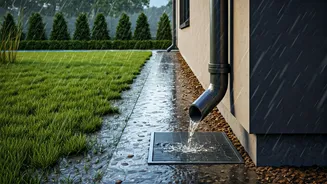
Your home's first line of defense against a deluge is its gutter system. These simple channels are designed to catch thousands of gallons of water and direct it safely away from your house. But when they're clogged with a winter's worth of leaves, dust,
and debris, they fail spectacularly. Instead of funneling water away, they overflow, sending water cascading down your walls, saturating the ground right next to your foundation, and potentially seeping into your home. Your task is simple but essential. Safely, from a sturdy ladder, clear out all the gunk. A small trowel or a gutter scoop works well. Once the large debris is gone, use a garden hose to flush the gutters and downspouts. This not only clears out the finer sediment but also shows you if there are any hidden blockages or leaks. If water isn't flowing freely out of the bottom of your downspouts, you may have a clog you need to snake. Ensure downspouts point at least five to six feet away from the foundation.
Check the Slope: Grading Around Your Foundation
Water's worst enemy is a good slope. The ground immediately surrounding your house should be graded to slope away from it, a concept known as "positive grading." This encourages water to flow away from your foundation, not pool against it. During a monsoon downpour, even a slight negative grade—where the ground slopes toward your house—can create a moat of water looking for any tiny crack to exploit. Take a walk around your home's perimeter. Do you see areas where the soil has settled, creating low spots next to the foundation? Is mulch piled up high against the siding? The ideal slope is a drop of about six inches over the first ten feet away from the house. While re-grading your entire yard is a huge job, you can make a big difference by simply buying a few bags of clean fill dirt and building up the soil right against your foundation to create a gentle, outward-sloping ramp.
Clear the Pathways: Swales, Drains, and Scuppers
Many properties, especially in planned communities in the Southwest, have built-in drainage features like swales and area drains. A swale is just a shallow, broad ditch, often covered in grass or rock, designed to act as a man-made creek bed during a storm. Area drains are small grates in patios, lawns, or low spots connected to underground pipes. For homes with flat roofs and parapet walls, scuppers—drains that pass through the wall—are critical. These systems only work if they are clear. Before the season starts, rake leaves, sticks, and other debris out of your swales. Pull the grates off your area drains and scoop out the mud and gunk that has accumulated inside. For scuppers, make sure nothing is blocking their entrance on the roof or their exit on the other side of the wall. You're creating a clear, unobstructed path for stormwater to follow, directing it to the street or a designated drainage area.
Inspect Your Home's Weak Points
Now that you've managed the flow of water, it's time to check the barriers. Walk the perimeter and look closely at your foundation. Are there any visible cracks where water could penetrate? Small hairline cracks can often be sealed with a concrete caulk or epoxy injection. Also, check your window wells. These corrugated metal or plastic shields can fill up with water like a bathtub if their drains are clogged with leaves. Scoop them out and make sure the drain at the bottom is clear. Finally, inspect the seals around your exterior doors, especially those at ground level or on a patio. Is the weatherstripping cracked or peeling? A poorly sealed door is an open invitation for wind-driven rain to find its way inside. A few dollars spent on new weatherstripping can prevent hundreds of dollars in water damage to your flooring and subfloor.