




Meet the 'Visitor'
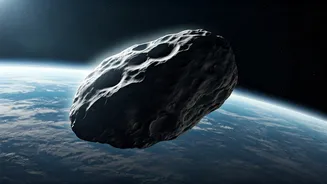
The object in question is a type of space rock known as a near-Earth asteroid (NEA). Let's give it a name to make it less anonymous: an object similar to one that passed us recently, named 2023 DZ2. At around 200 feet in diameter, it’s about the size
of a 20-story building or the length of a Boeing 747. Discovered by astronomers as part of a global network that scans the skies, this asteroid is one of thousands of objects whose orbits bring them into Earth’s neighborhood. It’s not an alien spaceship or a harbinger of doom; it’s a rocky remnant from the formation of our solar system, a 4.5-billion-year-old time capsule that’s been looping around the sun on a predictable path. Its 'visit' isn't a surprise—it's an appointment we've known about for a while.
How Close Is 'Close'?
In cosmic terms, 'close' is relative. When you hear 'close approach,' your mind might leap to a near-miss, but the reality is far more comfortable. An asteroid like 2023 DZ2 passed Earth at a distance of about 100,000 miles. While that sounds close, it’s less than half the distance to the Moon. To put it another way, if the Earth were a basketball in New York City, the Moon would be in Philadelphia, and this asteroid would fly by somewhere around Newark, New Jersey. It's close enough to be fascinating for scientists but nowhere near close enough to pose a threat. NASA and other space agencies are extremely confident in their trajectory calculations. They've stated unequivocally that there is a 0% chance of impact. This isn’t a guess; it’s a conclusion based on precise tracking and orbital mechanics.
Can You See It?
Despite its impressive size, don't expect to walk outside and see a fiery streak across the sky. A 200-foot object, even at 100,000 miles away, is incredibly faint. For the brief period it's at its brightest, it will be invisible to the naked eye. To catch a glimpse, you’d need a good-sized amateur telescope (at least 6-8 inches in diameter) and a very dark sky, far from city lights. You'd also need to know exactly where to look. For most of us, the best way to 'see' the flyby is through the lens of science—watching live streams from observatories or seeing the images and data that astronomers will be capturing. It’s less of a public spectacle and more of a scientific opportunity.
A Gift for Science
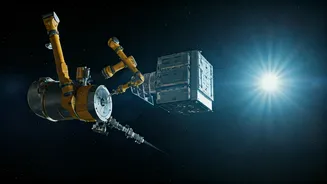
For scientists, this flyby is like having a sample of the solar system delivered right to our celestial doorstep for free. Because the asteroid gets so close, it becomes a prime target for study. Using powerful radar and optical telescopes, researchers can map its surface, determine its shape and rotation, and get clues about its composition—is it a solid chunk of rock, or more of a loose 'rubble pile' held together by gravity? These details are invaluable. They help us understand the building blocks of planets and, more practically, provide crucial information for planetary defense. Every near-miss is a dress rehearsal. Understanding what these rocks are made of is key to figuring out how to deflect one if it were ever on a collision course with Earth, as demonstrated by NASA's successful DART mission, which intentionally crashed a spacecraft into an asteroid to alter its path.