





Why 'Monsoon' Season Is Everywhere Now
While the term “monsoon” might bring to mind the dramatic rainy seasons of South Asia, the concept of a prolonged period of intense, disruptive weather is becoming an unfortunate reality across the United States. Think of hurricane season on the East
and Gulf Coasts, the atmospheric rivers hitting the West Coast, or the severe summer thunderstorms that can knock out power grids in the Midwest. These events aren't just inconvenient; they represent a fundamental shift in travel planning. A storm doesn't have to be a named hurricane to cause localized blackouts that can last for hours or even days. In these moments, access to power isn't about comfort—it's about safety, communication, and information. The assumption that your hotel or rental will have consistent electricity is no longer a guarantee, making personal energy sources a critical part of any modern traveler’s kit.
The Power Bank as a Digital Lifeline
We often think of a dead phone as a social inconvenience, but during a weather-related emergency, it’s a critical failure. Your smartphone is your link to the outside world. It’s how you receive emergency weather alerts from services like FEMA and the National Weather Service. It’s your map for navigating unfamiliar areas, which may have flooded or blocked roads. It’s your primary tool for contacting emergency services or letting loved ones know you’re safe. Furthermore, many of us store digital copies of crucial documents—passports, flight information, hotel confirmations—on our devices. When the power goes out and your phone battery drains to zero, you’re not just disconnected; you’re isolated and vulnerable. A reliable power bank ensures this digital lifeline remains active, transforming it from a simple accessory into a non-negotiable piece of safety equipment.
What to Look For: Capacity (mAh)
When shopping for a power bank, the most important number you’ll see is its capacity, measured in milliamp-hours (mAh). This figure tells you how much energy the battery can hold. Don’t get bogged down in the technicalities; think of it in practical terms. A typical modern smartphone has a battery capacity between 3,000 and 5,000 mAh. For general guidance: - **10,000 mAh:** This is the sweet spot for most travelers. It's usually compact enough for a daypack and can provide about two full charges for a standard smartphone. It's perfect for a weekend trip where you might face a short-term outage. - **20,000 mAh or more:** This is your emergency-preparedness tier. A power bank this size can charge a phone multiple times or keep multiple devices (like a tablet or headphones) topped up. While heavier, it provides invaluable peace of mind for week-long trips, family travel, or any situation where you anticipate being off-grid for an extended period.
What to Look For: Ports and Charging Speed
Capacity is only half the story. You also need to ensure the power bank can efficiently deliver its energy to your specific devices. First, look at the ports. Most modern power banks come with a mix of USB-A (the classic rectangle) and USB-C (the smaller, oval-shaped port). For future-proofing, prioritize models with at least one USB-C port, as most new devices use this standard. Next, consider charging speed. Look for features like “Power Delivery” (often abbreviated as PD), especially for USB-C ports. PD technology allows for much faster charging of compatible devices, like newer iPhones and Android phones. This is a game-changer during an emergency, when you might only have a brief window to recharge. A power bank with PD can charge your phone to 50% in about 30 minutes, whereas a standard, slow charger might take over an hour to achieve the same result.
What to Look For: Durability and Extra Features
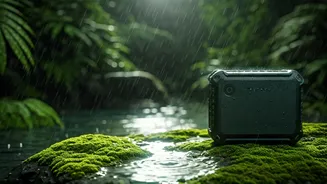
If you're buying a power bank for storm season travel, it needs to be able to handle less-than-ideal conditions. Look for models described as “rugged” or “durable.” Some come with rubberized bumpers to protect against drops on hard surfaces. A key feature to consider is water resistance, indicated by an IP rating (e.g., IP67). While you probably won't be submerging your power bank, a water-resistant model can easily survive being used in the rain or getting splashed. Finally, don't overlook built-in extra features. Many power banks designed for outdoor or emergency use include a built-in LED flashlight. This might seem like a minor addition, but in a blackout, having a reliable, long-lasting light source integrated with your power source is incredibly useful, saving you from having to pack and keep track of a separate flashlight.