










The Government Opens the Airlock
For fifty years, India’s space ambitions ran through one entity: the Indian Space Research Organisation (ISRO). Think of it as India’s NASA—a highly successful, government-funded behemoth famous for incredibly cost-effective missions, like its Mars orbiter
that cost less than the movie Gravity. But it was a closed shop. If you wanted to build a rocket in India, you were effectively locked out. That all changed in 2020. In a landmark policy shift, the Indian government threw open the doors to the final frontier, inviting private companies to design, build, and launch their own rockets and satellites. It created a new regulatory body, IN-SPACe, to act as a bridge between the private sector and ISRO’s formidable infrastructure. The move was less an invitation and more of a starting gun, kicking off a private space race that is now hitting its stride.
Meet India's SpaceX Contenders
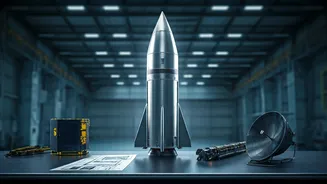
The result of this policy shift is a vibrant ecosystem of over 100 space-tech startups, each tackling a different piece of the cosmic puzzle. The two names generating the most buzz are Skyroot Aerospace and Agnikul Cosmos. Think of them as the early-stage SpaceX and Rocket Lab of India. In late 2022, Skyroot made history by launching Vikram-S, India’s first-ever privately developed and built rocket. While a suborbital test flight, it was a massive proof-of-concept, signaling that the private sector could deliver. Hot on their heels is Agnikul, which has distinguished itself by 3D-printing its rocket engines in a single piece—a complex manufacturing feat aimed at slashing production time and cost. These aren't just paper projects; they are backed by tens of millions in venture capital and have very real hardware.
The Secret Sauce: Frugal Innovation
So, how are these startups competing? They have a uniquely Indian advantage often referred to as “jugaad,” or frugal innovation. It’s a mindset focused on creating ingenious, low-cost solutions to complex problems. While Western companies spend billions, Indian entrepreneurs are leveraging this cultural and engineering DNA to build space tech at a fraction of the price. Skyroot and Agnikul are developing small satellite launch vehicles that aim to serve the booming global market for deploying smallsats—a market currently dominated by pricey, infrequent rideshares on larger rockets. By offering dedicated, affordable launches, they plan to become the go-to 'space couriers' for satellite companies worldwide. Their goal isn't just to be cheaper than SpaceX, but to create an entirely new, more accessible market segment.
It’s Not Just About the Rockets
The boom extends far beyond launch vehicles. The real money in the modern space economy is often in the data collected from orbit. Here, companies like Pixxel are making waves. Pixxel is building a constellation of hyperspectral imaging satellites—essentially, cameras in space that can see the world in hundreds of colors beyond what the human eye can perceive. This technology has profound implications for everything from agriculture (monitoring crop health with incredible precision) to mining (identifying mineral deposits) and climate change (tracking emissions and environmental damage). By capturing and analyzing this unique data, Pixxel and others are creating value that has nothing to do with blast-offs and everything to do with actionable intelligence for businesses and governments on Earth.