






Why a New Moon Is a Stargazer’s Best Friend
In the world of stargazing, the moon is both a beauty and a beast. While a full moon can be a spectacular sight, its bright light acts as a form of natural light pollution, washing out fainter stars, meteor showers, and the delicate structures of the Milky
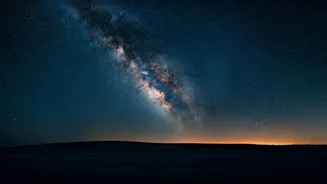
Way. It’s like trying to watch a movie with the house lights on. A new moon, however, is the opposite. During this phase, the moon is positioned between the Earth and the sun, so the side facing us is not illuminated. It rises and sets with the sun, meaning it’s completely absent from the night sky. This celestial alignment gives us a precious window of true darkness, creating the ideal canvas for viewing the cosmos. Without the moon’s glow interfering, the sky reveals its full depth and brilliance. Stars that are usually invisible to the naked eye suddenly pop into view, and familiar constellations appear sharper and more crowded with stellar neighbors. This is the “ultimate” viewing condition the pros wait for.
The Taurus Connection: Timing is Everything
So, what does Taurus have to do with it? When astronomers and astrologers refer to the “Taurus New Moon,” they mean that the sun and the moon are aligned in the part of the sky occupied by the constellation Taurus. For stargazers in the Northern Hemisphere, this typically occurs in late April or May. While Taurus itself will be invisible (as it’s in the same direction as the sun), its timing signals the arrival of the classic spring constellations. This new moon serves as a celestial reminder that the sky is transitioning away from winter favorites like Orion and into a new season of cosmic sights. It’s a prompt to shift your gaze toward the patterns that will dominate the late spring and early summer nights. Think of it less as a sign to look *at* Taurus and more as a starting gun for a new season of incredible stargazing opportunities.
What to Look for in the Spring Sky
With the moonlight out of the way, a whole new cast of characters emerges. Point your eyes upward and look for these springtime highlights: Leo the Lion: One of the most recognizable spring constellations, Leo is marked by a backward question mark of stars that form the lion's head and mane. The brightest star, Regulus, sits at the bottom of the question mark. The Big Dipper and the North Star: High in the northern sky, the Big Dipper is your best guide. Follow the two stars at the end of the Dipper's “bowl” straight up to find Polaris, the North Star. The Dipper's handle also makes a gentle arc you can “follow to Arcturus,” a bright orange star in the constellation Boötes. Virgo and the Realm of Galaxies: To the southeast of Leo, you’ll find the sprawling constellation Virgo, home to the bright star Spica. This region of the sky is famous among astronomers because it contains the Virgo Cluster, a massive collection of thousands of galaxies. While you’ll need a telescope to see most of them, the sheer knowledge that you’re looking toward a city of galaxies is awe-inspiring. The Early Milky Way: While the Milky Way’s bright core is a summer spectacle, its fainter arms begin to stretch across the eastern horizon late on these spring nights. In a truly dark location, you’ll see it as a hazy, luminous band of light rising after midnight.
Your Guide to a Perfect Stargazing Night
To make the most of this dark-sky opportunity, a little preparation goes a long way. First, get away from city lights. Even a 30-minute drive outside of town can make a dramatic difference. Find a park, a rural road, or a designated dark-sky area. Second, give your eyes time to adapt. It takes about 20-30 minutes for your pupils to fully dilate and adjust to the darkness, unlocking your natural night vision. Avoid looking at your bright phone screen during this time. If you need light, use a red flashlight or a red-light filter on your phone, as red light is less disruptive to your night vision. Finally, get comfortable. Bring a blanket or a reclining chair, dress in warm layers (nights get cold even in spring), and pack some hot chocolate. Stargazing apps like SkyView Lite or Stellarium can help you identify what you’re looking at by simply pointing your phone at the sky—just be sure to switch to their red-light night mode.