





An Impossible Storm
Let’s get the obvious question out of the way: there is no such thing as a Category 79 hurricane. The Saffir-Simpson scale, which we use to measure hurricane intensity, tops out at Category 5 for storms with sustained winds of 157 mph or more. The scale is a human
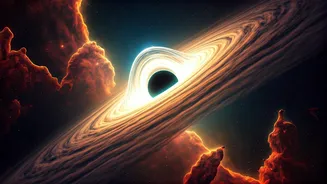
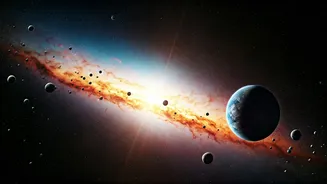
invention for an Earth-bound problem. So when scientists use a number like 'Category 79,' they’re not being literal; they're trying to find a metaphor powerful enough for a phenomenon that defies our everyday experience. The source of these unfathomable winds is a quasar known as PDS 456, located more than 2 billion light-years from Earth. At its heart lies a supermassive black hole, and as this cosmic engine devours surrounding matter, it unleashes torrents of energy and particles. Using observations from NASA's NuSTAR telescope and the European Space Agency's XMM-Newton, astronomers detected what they call 'ultra-fast outflows,' or UFOs. These are not gentle breezes. They are continuous, spherical tsunamis of charged particles blasting outward in every direction.
Putting the Speed in Perspective
So, how fast is this cosmic 'wind'? The outflows from PDS 456 are moving at approximately one-third the speed of light. That’s roughly 200 million miles per hour. Let’s try to wrap our heads around that. The fastest hurricane winds ever recorded on Earth topped out around 200 mph. The black hole’s winds are, quite literally, one million times faster.
If you could somehow stand in this blast (you can’t), you would be scoured out of existence in an instant. A journey from New York to Los Angeles at this speed would take less than a tenth of a second. It's a velocity so extreme that it almost loses meaning. The hurricane analogy, while technically inaccurate, is one of the only ways to convey the sheer, unadulterated violence of the event. It’s like comparing the pop of a firecracker to a hydrogen bomb; both are explosions, but the comparison breaks down at the sheer difference in scale.
It's Not Actually 'Wind'
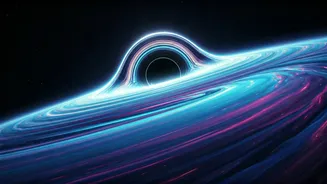
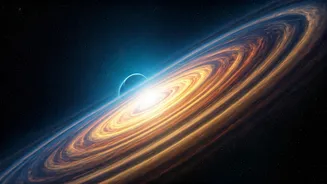
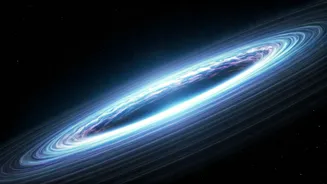
When we think of wind, we picture moving air—molecules of nitrogen and oxygen rushing through the atmosphere. That’s not what’s happening here. A black hole itself has no atmosphere to create wind. Instead, the 'wind' is a torrent of superheated matter. As dust and gas spiral into the black hole, they form a blisteringly hot, bright structure called an accretion disk.
The energy and radiation pouring off this disk are so intense they can physically shove matter outward with incredible force. It’s less like a weather system and more like a continuous, shotgun-like blast of high-energy particles fired in all directions. This outflow is so powerful that it carries away more matter in a single year than what’s contained in our sun. This isn’t a storm; it’s a star-eater’s furious exhaust.
The Galaxy's Thermostat
As mind-boggling as these outflows are, they aren't just cosmic curiosities. They play a crucial role in shaping the universe itself. A galaxy needs a reservoir of cool gas to form new stars. These powerful black hole winds act like a galactic-scale leaf blower, blasting this star-forming gas out of the galaxy entirely.
In doing so, the black hole effectively stunts its own galaxy's growth. It puts a cap on how many new stars can be born, acting as a kind of cosmic thermostat that regulates the galaxy's life cycle. Scientists believe this process is a key reason why massive galaxies don't just keep growing indefinitely. By studying extreme outflows like those from PDS 456, astronomers are essentially looking at the DNA of galaxy formation, understanding the violent feedback loop between the monsters at their centers and the starry cities they inhabit. The 'weather' from a black hole, it turns out, can determine the fate of trillions of stars.