








Your Skeleton Thins Out
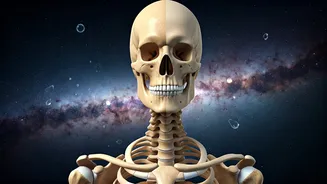
On Earth, every step you take sends a tiny jolt through your skeleton, signaling your bones to stay dense and strong. In the microgravity of space, that signal disappears. Without the constant load-bearing work, the body assumes the skeleton is no longer
needed and starts reabsorbing it. Astronauts can lose bone mass at a rate of 1% to 1.5% per month, primarily in their hips and spine. This is like getting a severe case of osteoporosis at warp speed. To combat this, astronauts on the International Space Station (ISS) spend about two hours a day on specialized exercise equipment, including treadmills and resistance machines, to simulate the stress of gravity and trick their bones into sticking around.
You Get a Puffy Face and Skinny Legs
Here on the ground, gravity pulls about two liters of fluid down into your legs. In space, that fluid redistributes evenly throughout the body, migrating upwards into the torso and head. This creates a strange and uncomfortable phenomenon astronauts call "puffy-head, bird-legs." Their faces swell, their sinuses get congested (leading to constant "space sniffles"), and their legs shrink as they lose fluid volume. This isn't just a cosmetic issue; the fluid shift fools the body into thinking it has too much water, causing it to excrete more fluid and leading to a state of constant, low-level dehydration.
Your Vision Can Permanently Change
One of the most serious and mysterious risks of long-duration spaceflight is Space-Associated Neuro-ocular Syndrome (SANS). The same fluid shift that causes a puffy face also increases pressure inside the skull. This pressure can flatten the back of the eyeball, cause folds in the retina, and inflame the optic nerve. The result? Many astronauts develop farsightedness during their missions. While this can sometimes resolve upon returning to Earth, for some, the changes are permanent. NASA considers SANS a top-priority health risk, as protecting astronauts' vision is critical for the success of future multi-year missions to places like Mars.
Your Sense of Balance Goes Haywire
Your inner ear contains a sophisticated vestibular system that tells your brain which way is up. In space, that system goes completely haywire. Without a clear gravitational pull, the signals it sends become a confusing jumble. For the first few days in orbit, about half of all astronauts experience Space Adaptation Syndrome—a cosmic cousin of motion sickness that involves severe nausea, disorientation, vomiting, and headaches. Astronauts learn to rely more on visual cues—seeing their crewmates' feet pointing in one direction—to orient themselves. Eventually, the brain adapts by largely ignoring the signals from the inner ear.
You're Soaked in More Radiation
Earth is wrapped in a protective magnetic field that shields us from the vast majority of harmful space radiation. Once you leave that bubble, you're exposed to a constant shower of high-energy galactic cosmic rays and particles from solar flares. An astronaut on a six-month mission to the ISS receives a radiation dose roughly 30 times greater than what a person on Earth gets in a year. This exposure increases their lifetime risk for cancer, cataracts, and potential degenerative diseases. For a potential three-year round trip to Mars, radiation exposure is one of the single biggest medical hurdles to overcome.
Coming Home Is Its Own Ordeal
After months of floating, returning to Earth’s 1g environment is a shock to the system. Astronauts often feel immensely heavy and struggle with coordination and balance as their brain relearns to process gravitational signals. Simple acts like walking or holding up their own head can be exhausting. Muscle weakness and bone density loss require a rigorous, months-long physical rehabilitation program. It's a harsh reminder that while humans may dream of the stars, our bodies were built for Earth, and they fight to remember how to live here.