
What Exactly Is Fruit Custard?
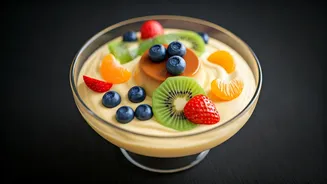
Before we dive into its comeback, let’s get on the same page. Fruit custard is less a strict recipe and more a beautiful, simple concept. At its core, it’s a chilled dessert made from a silky, vanilla-kissed custard—often made from a box, no shame—mixed
with a medley of chopped fresh or canned fruit. Think grapes, bananas, apples, mangoes, and pomegranate seeds suspended in a creamy, sweet sauce. It’s not a French pot de crème or a British trifle, though it shares some DNA. It’s the potluck hero, the easy weeknight treat, the dessert that feels both special and completely unfussy. Its identity is rooted in accessibility. No special equipment, no complex techniques, just a bowl of pure, unadulterated comfort that comes together in minutes.
A Big Bowl of Edible Nostalgia
A huge part of fruit custard’s modern appeal is its powerful connection to the past. For many Americans, it evokes a specific kind of memory: a church potluck, a family barbecue, or a Tupperware container appearing from the fridge after dinner. It’s a taste of a time when dessert didn’t need to be an Instagram-worthy event. In our current landscape of high-stress news cycles and economic uncertainty, we’re collectively craving comfort. Food is one of the easiest ways to access that feeling. While a sourdough starter demands commitment and a croquembouche requires architectural engineering, fruit custard asks for nothing but a bowl and a spoon. It’s a culinary security blanket, reminding us of simpler times and the uncomplicated joy of a sweet treat made with love, not for likes.
The Unpretentious Anti-Foodie Dessert
The last decade of food culture has been defined by a certain kind of performative perfection. We’ve seen gravity-defying cakes, hyper-realistic pastries, and dishes plated with tweezers. While beautiful, this trend can also feel intimidating and exclusive. Fruit custard is the gentle antidote to that pressure. It’s inherently a little messy, a little homely, and completely delicious. There’s no “right” way to plate it; you just spoon it into a bowl. The fruit doesn’t need to be perfectly uniform, and the custard can be as simple as you like. This lack of pretension is its superpower. It represents a shift away from food as a status symbol and a return to food as sustenance—both for the body and the soul. It’s a dessert that’s meant to be eaten, not just photographed.
Finding a New Generation of Fans
While its roots are in mid-century kitchens, fruit custard is finding a surprisingly enthusiastic audience among younger generations. On platforms like TikTok and Instagram, where authenticity is a prized currency, the simple charm of this dessert resonates. For one, it’s incredibly budget-friendly, often relying on pantry staples and whatever fruit is on hand. In an age of rising grocery costs, an affordable and satisfying dessert is a huge win. Furthermore, its simplicity makes it a perfect entry point for new cooks who might be overwhelmed by more complex recipes. Global variations, like the popular Indian version often made with milk powder and tropical fruits, are also introducing the concept to a wider audience, showcasing its versatility and cross-cultural appeal. It’s proof that a good idea, no matter how old, can always find a new moment to shine.