




So, What Exactly is Rath Yatra?
At its heart, the Rath Yatra (meaning “Chariot Journey”) is a massive annual Hindu festival originating from the city of Puri in Odisha, India. It’s one of the oldest and largest religious processions in the world. The festival honors Lord Jagannath,
a form of the deity Vishnu, along with his elder brother Balabhadra and younger sister Subhadra. The central event involves transporting these three deities from their home in the main Jagannath Temple to the Gundicha Temple, a smaller temple about two miles away, which is considered their “aunt’s summer home.” It’s a vacation for the gods, and the entire community is invited to facilitate their journey. The festival symbolizes equality and unity, as people from all walks of life, regardless of caste or creed, can get a glimpse of the deities and even participate by pulling the chariots’ ropes—an act considered incredibly auspicious.
The Deities and Their Unique Look
If you’ve seen images of the deities, you might notice their distinct and unconventional appearance. Lord Jagannath, Balabhadra, and Subhadra are depicted with large, round eyes, no discernible limbs, and a stylized, almost abstract form. Carved from sacred wood, these forms are rooted in tribal art and local legends that predate classical Hinduism. One popular story tells of a king who commissioned the idols, but the divine carpenter who was carving them insisted on not being disturbed. When the queen, growing impatient, opened the door too early, the carpenter vanished, leaving the deities unfinished. This incomplete form is seen as perfect in its imperfection, representing a deity that is accessible, beyond conventional form, and embraces all beings. During the Rath Yatra, these revered figures leave the sanctum sanctorum of the temple, offering a rare public viewing, or *darshan*, to devotees who might otherwise not be allowed inside.
Engineering an Act of Devotion
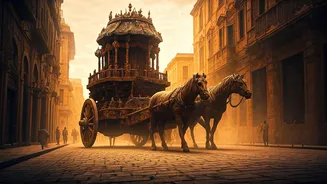
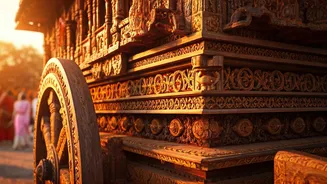
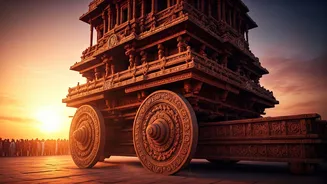
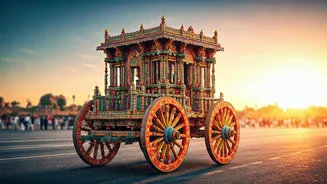
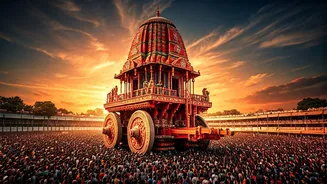
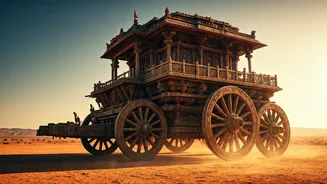
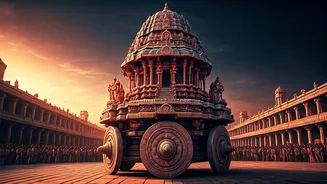
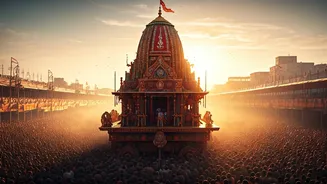
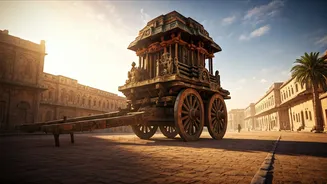
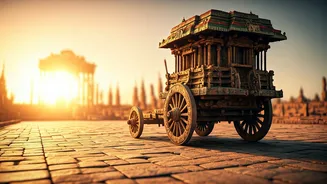
The “full scale” in the headline is no exaggeration. The three chariots are architectural marvels, built new from scratch every single year according to strict ancient specifications. They are not merely floats; they are temporary mobile temples. Lord Jagannath’s chariot, Nandighosha, stands about 45 feet tall and runs on 16 massive wheels, each seven feet in diameter. The other two are slightly smaller. A specific community of carpenters and artisans, whose families have held this duty for generations, use traditional tools and techniques to construct them from designated types of wood. Once built, the chariots are adorned with vibrant fabrics, flags, and carvings. The sheer scale and the fact that they are human-powered—pulled by thousands of devotees using thick coir ropes—is a powerful testament to collective faith and physical devotion.
From Puri to the Streets of America
While the celebration in Puri is the original and largest, the Rath Yatra has become a global phenomenon. Thanks largely to the efforts of A.C. Bhaktivedanta Swami Prabhupada, founder of the International Society for Krishna Consciousness (ISKCON), the festival was first brought to the West in 1967 in San Francisco. Today, “Festival of Chariots” parades are a common sight in major cities across the United States, from New York and Washington D.C. to Los Angeles and Chicago. These American celebrations replicate the core rituals, with smaller but still impressive chariots pulled through city streets, accompanied by music, chanting, and the distribution of sanctified food (*prasadam*). For many Hindu Americans, it’s a vital way to connect with their heritage. For their neighbors, it’s an open invitation to witness and even participate in a vibrant, joyful cultural tradition that has traveled thousands of miles.