






The Myth: A Buried Pyramid or Alien Base
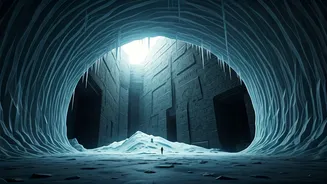
Every few years, the internet rediscovers Antarctica. Satellite images showing pyramid-shaped mountains or strange-looking ice formations go viral, fueling claims of a lost civilization or an extraterrestrial outpost. These theories often point to a perfectly
symmetrical anomaly as proof of artificial design, hidden from the world by a global conspiracy. The stories are tantalizing, playing on our collective fascination with ancient mysteries and the unknown. They suggest that a structure, perhaps older than any we know, is waiting to be uncovered. However, these claims universally lack scientific evidence. Geologists have explained that the 'pyramids' are simply nunataks—mountain peaks weathered by freezing and thawing into pyramidal shapes, a natural geological process. The idea of a man-made structure remains firmly in the realm of fiction.
The Reality: A Massive Gravity Anomaly
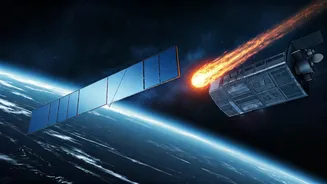
The real story is, in many ways, more staggering than the myth. Scientists haven't found a pyramid, but they have found something enormous. In 2006, a team of researchers using NASA's GRACE satellites detected a huge gravitational anomaly in an area known as Wilkes Land. A gravity anomaly is a place where the pull of gravity is unexpectedly strong. This suggests that something incredibly dense, a huge mass of material, is lurking beneath the ice. The satellites detected a 'mascon'—a mass concentration—over 300 miles wide, centered within a much larger circular ridge visible in radar scans of the bedrock. This wasn't a building; it was a feature of the planet's crust itself, hidden more than a mile beneath the frozen surface.
The Leading Theory: A Colossal Impact Crater
So what is this massive, dense 'structure'? The leading scientific theory is that it’s a gargantuan impact crater, the scar left by an asteroid or comet that collided with Earth. Researchers from Ohio State University proposed that the mascon is a plug of dense mantle material that rose up into the crust after it was catastrophically punctured. The object that created this crater would have been immense—perhaps 30 miles wide, making it more than four times larger than the asteroid believed to have wiped out the dinosaurs. The crater itself is estimated to be twice the size of the Chicxulub crater in Mexico. This isn't just a structure *on* the land; it's a fundamental change *to* the land, a wound on the planet that has been hidden by ice for millions of years.
Why This Discovery Is So Important
The implications of this impact crater are profound. Scientists have dated the event to roughly 250 million years ago, which coincides perfectly with the Permian-Triassic extinction event. Known as 'The Great Dying,' this was the most severe extinction in Earth's history, wiping out about 96% of all marine species and 70% of terrestrial vertebrate species. For years, scientists have debated the cause, often pointing to massive volcanic eruptions in Siberia. But the discovery of the Wilkes Land crater provides a compelling alternative—or complementary—theory. An impact of this magnitude would have sent shockwaves around the globe, triggered epic tsunamis, and blotted out the sun, radically altering the climate and causing a planet-wide collapse of ecosystems. It's also hypothesized that the impact may have helped fracture the supercontinent Gondwana, leading to the creation of Australia.