




The Cooktop Gets a Clean Upgrade
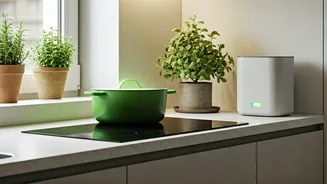
For decades, the debate was gas versus electric. Today, the conversation has a new, far more efficient frontrunner: induction. Unlike traditional stovetops that heat a surface which then heats a pan, induction uses magnetism to directly heat the cookware
itself. This isn't just a neat party trick; it's a massive energy win. Up to 90% of the energy from an induction cooktop is transferred to the food, compared to roughly 74% for standard electric and a mere 40% for gas. By eliminating this wasted heat, induction cooktops not only cook faster and offer more precise temperature control, but they also slash the energy required for a meal. Beyond efficiency, there's a significant health and environmental benefit. A growing body of research highlights the indoor air pollution caused by natural gas stoves, which release nitrogen dioxide and other harmful compounds directly into your home. Making the switch to induction effectively eliminates this kitchen-based fossil fuel combustion, creating cleaner air where you cook and reducing demand on the gas grid. It’s the single biggest ‘green energy’ move you can make at the stove.
Smarter Appliances, Silent Savings
The real energy story in a kitchen isn't always the dramatic sizzle of a pan; it's the quiet, constant hum of the refrigerator or the nightly cycle of the dishwasher. These background players are responsible for a significant chunk of a home’s energy bill. This is where the ‘big’ in ‘Big Green Energy’ starts to take shape through collective upgrades. Modern Energy Star-certified appliances are engineered for radical efficiency. A new refrigerator, for example, can use less than half the energy of a model from 20 years ago. Smart dishwashers use soil sensors to optimize water and energy use for each specific load, often using far less water than washing by hand. This isn't about sacrificing performance. Today’s efficient models are better in every respect, with improved insulation, smarter compressors, and innovative features. The green energy ‘grown’ here is the energy *not* used. When millions of households replace aging, inefficient appliances, the cumulative reduction in demand on the power grid is enormous—equivalent to shutting down entire power plants.
From Food Scraps to Fuel
Here's where the 'growing' in the headline becomes literal. An estimated 30-40% of the food supply in the U.S. is wasted, and much of that waste happens in our own kitchens. When banana peels, coffee grounds, and leftovers go into the trash, they end up in landfills, where they decompose and release methane, a potent greenhouse gas. The new wave of kitchen sustainability tackles this problem head-on. Countertop electric composters are a game-changer for small spaces, quickly breaking down food scraps into a nutrient-rich 'dirt' that can be used for houseplants or gardens. But the energy connection goes deeper. At a municipal level, collected food waste is increasingly being sent to anaerobic digesters. In these facilities, microorganisms break down the organic material in an oxygen-free environment, creating biogas—a renewable energy source that can be used to generate electricity or heat. By separating your food scraps, your small kitchen becomes the first step in a powerful green energy supply chain, literally turning last night’s dinner into next week’s power.
The Network Effect of Small Choices
A single induction cooktop or one family composting might seem like a small drop in a very large bucket. But the power of this movement isn’t in any single action; it’s in the network effect. The kitchen is becoming a decentralized hub for climate action, where individual consumer choices aggregate into massive-scale change. This shift is driven by a combination of technological innovation, growing environmental awareness, and government incentives that make these upgrades more accessible. When a neighborhood adopts induction, it reduces local pollution. When a city implements a composting program, it creates a new energy source. The ‘Big Green Energy’ isn't a single, monolithic power plant. It’s the distributed, collective power of millions of smarter, cleaner, more efficient kitchens working in concert. It's proof that sometimes the biggest revolutions start in the most familiar of places.