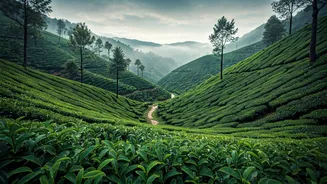









An Ocean of Emerald Hills
Before the clouds roll in, there is the green. Perched high in the Western Ghats mountain range in India’s southern state of Kerala, Munnar is a world draped in tea. The plantations here are not just fields; they are a sprawling, manicured wilderness.
Contoured, terraced, and sculpted, they ripple across the hills like waves on a green ocean, stretching as far as the eye can see. At altitudes rising up to 6,000 feet, the air is crisp and clean. The sun casts sharp shadows, defining every single row of meticulously trimmed Camellia sinensis bushes. Workers, visible as small dots of bright color against the foliage, move with a practiced rhythm, their hands plucking the tender leaves that will eventually find their way into teacups around the globe. It's a scene of immense scale and profound order, a man-made wonder that feels perfectly harmonized with nature.
The Approaching Mist
But in Munnar, especially during the monsoon season, this perfect clarity is fleeting. The change begins not with a thunderclap, but with a whisper. A cool breeze suddenly snakes through the valleys, making the silver oak trees shimmer and the tea leaves rustle in unison. The light shifts, losing its golden warmth and taking on a diffused, ethereal quality. Far in the distance, the sharp peaks of the mountains begin to soften as the first tendrils of mist creep over the ridges. It moves not like weather, but like a living thing—a silent, advancing tide of white. The birdsong quiets, replaced by a deep, expectant hush. This is the moment of anticipation, the quiet breath the landscape takes before the performance begins. The air becomes heavy with moisture, carrying the faint, sweet fragrance of tea blossoms and damp earth.
A Symphony of Rain and Green
Then, it happens. The mist doesn’t just arrive; it consumes. It pours down the hillsides in thick, billowing clouds, swallowing the view in sections until you are enveloped in a soft, grey cocoon. The rain that follows is rarely a torrent. It's a 'misty rain,' a uniquely Keralan phenomenon known as a drizzle or 'nool mazha' (thread rain). It’s a fine, persistent spray that hangs in the air, coating every surface in a diamond-like sheen. The sound is a gentle, rhythmic 'shhhh' on millions of leaves. The vibrant green of the tea gardens deepens, becoming richer and more saturated under the wetness. Water trickles down the pathways, forming tiny, temporary streams. Watching the layers of fog drift through the valleys, revealing and concealing patches of the tea-covered slopes, is a mesmerizing, almost meditative experience. It’s a moving painting where the landscape is in constant, gentle flux.
The Soul of the Tea Garden
This rain is more than just a beautiful spectacle; it is the lifeblood of Munnar. The region’s unique microclimate, with its consistent rainfall and cool temperatures, is what makes the tea grown here so prized for its flavor and aroma. The monsoon replenishes the soil and nourishes the plants, ensuring the cycle of growth and harvest continues. The history of these gardens is steeped in the colonial past, established by British planters in the late 19th century, but today they are the heart of the local economy and a symbol of the region's identity. To see the rain fall here is to witness the very process that creates the world-famous Nilgiri and Kanan Devan teas. It’s a connection between the simple pleasure of a hot drink and the dramatic, soul-stirring beauty of its origin.