






So, What Exactly Is a Persimmon?
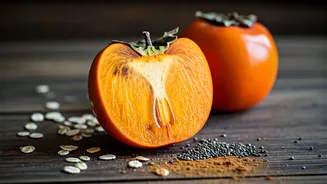
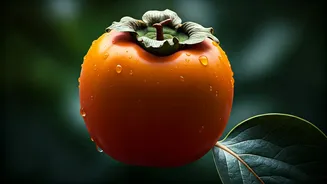
If you’ve walked past a display of glossy, orange-red fruit at the grocery store and wondered what they were, you’ve likely seen a persimmon. Often described as looking like a vibrant, smooth-skinned tomato, the persimmon is botanically a berry. Its name
comes from a Powhatan word meaning “a dry fruit,” which refers to the native American persimmon, but the varieties most common in U.S. markets originated in Asia. At its best, a ripe persimmon has a flavor profile that’s hard to pin down but easy to love: think a silky, honey-like sweetness with notes of apricot, pear, and a hint of cinnamon. Its texture is uniquely smooth and almost jelly-like when fully ripe, making it a decadent experience that feels far more indulgent than your standard grab-and-go fruit. It’s the kind of fruit that makes you stop and savor the bite, a welcome change of pace in a world of predictable flavors.
The Crucial Two-Persimmon Rule
Before you rush out to buy one, there’s one non-negotiable rule you must learn to avoid a truly unpleasant experience. There are two primary types of persimmons, and they are not interchangeable.
First is the **Hachiya**. It's acorn-shaped with a pointed bottom. Biting into an unripe Hachiya is a mistake you only make once. It’s full of tannins that create a powerfully astringent, chalky sensation that will make your mouth pucker instantly. Hachiyas are only ready to eat when they feel like a water balloon—squishy, soft, and so ripe you think they’ve gone bad. At that point, the tannins are gone, and you can scoop out the luscious, pudding-like flesh with a spoon.
Second is the **Fuyu**. This one is your friendly, entry-level persimmon. It’s squat and round, resembling a tomato. Fuyus are non-astringent, meaning you can eat them when they are still firm and crisp, just like an apple. You can slice them, dice them, and eat them skin-on. If you’re new to persimmons, start with a Fuyu.
Its 'Superfood' Resume
The term “superfood” is more of a marketing buzzword than a scientific category, but if any fruit is deserving of the hype, the persimmon makes a strong case. It’s a nutritional powerhouse hiding in a beautiful package. Persimmons are an excellent source of Vitamin A, which is crucial for vision, immune function, and skin health. A single persimmon can provide over half of the recommended daily intake.
They are also packed with Vitamin C, another immune-system booster, and manganese, a mineral important for bone health and metabolism. But their real superpower lies in their antioxidant content. They are rich in flavonoids and carotenoids, compounds that help fight cellular damage caused by free radicals. This antioxidant load contributes to its anti-inflammatory properties. Plus, with a healthy dose of fiber in each serving, persimmons are great for digestive health and helping you feel full and satisfied.
How to Bring Persimmons Into Your Kitchen
Now for the fun part: eating them. Thanks to their versatility, persimmons can be used in countless ways. For a firm Fuyu, the possibilities are endless. Slice it thin and add it to a fall salad with arugula, goat cheese, and pecans. Dice it up for a fresh salsa to serve with pork or chicken. You can even roast wedges with a little cinnamon and olive oil until they caramelize, serving them alongside roasted vegetables or as a simple dessert.
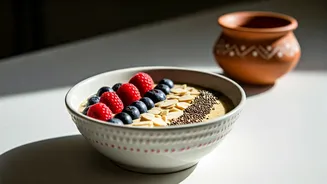
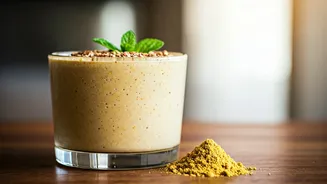
For a fully ripe, jelly-soft Hachiya, the simplest preparation is best. Cut it in half and eat the pulp with a spoon, as if it were a cup of natural custard. The rich puree can also be swirled into yogurt or oatmeal, blended into smoothies, or used as a base for baked goods like breads, muffins, and cookies, where its natural sweetness shines. When shopping, look for fruit with smooth, unblemished skin and a vibrant color. If they’re too firm, just leave them on your counter for a few days—they’ll soften right up.