






What Is This 'Sea Sparkle'?
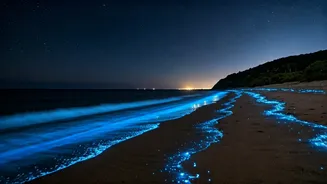
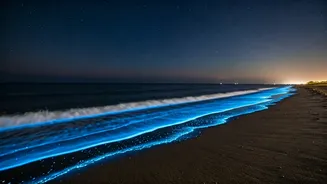
The ghostly glow painting the coast of Karnataka is a form of bioluminescence, the production of light by a living organism. In this case, the artist is a type of marine plankton called a dinoflagellate, specifically Noctiluca scintillans. Its name translates
to 'night light,' but it's more commonly known by the enchanting nickname 'sea sparkle.' These microscopic, single-celled organisms are a natural part of the marine ecosystem. They don't glow constantly; the light is a defense mechanism. When the water they're in is disturbed—by a breaking wave, a passing boat, or even a footstep on the wet sand—they flash a brilliant blue light for a fraction of a second. When millions of them are present in the water, their collective flashes create the mesmerizing, large-scale spectacle that has been drawing crowds and photographers to beaches like Mattu and Padukere.
A Celestial Shore on the Arabian Sea
While bioluminescence exists in oceans worldwide, these massive, concentrated blooms turning entire shorelines into a light show are relatively rare and unpredictable. The coastal districts of Udupi and Mangaluru in Karnataka have recently become hotspots for this stunning display. The phenomenon, locally called 'Kappe Samudra' by fishermen, typically occurs during the post-monsoon season, from late September to November. The combination of nutrient-rich waters following the rains, along with favorable temperatures and salinity, creates a perfect breeding ground for Noctiluca to multiply rapidly. The result is a 'bloom'—a massive concentration of organisms so dense that the water itself seems to come alive with light.
The Dark Side of the Dazzle
As breathtaking as it is, a massive 'sea sparkle' event isn't always a good sign for the ocean. Marine biologists view these intense blooms with a degree of caution. While Noctiluca scintillans itself is not toxic to humans, it can be a harbinger of an ecosystem under stress. These blooms are often fueled by an overabundance of nutrients (eutrophication) in the water, frequently linked to agricultural runoff containing fertilizers and untreated sewage from nearby cities flowing into the sea. The plankton feast on these excess nutrients, leading to their population explosion. The immediate beauty masks a potential long-term problem. When the massive bloom eventually dies, the decomposition process consumes huge amounts of dissolved oxygen in the water. This can create hypoxic 'dead zones' that suffocate fish and other marine life, disrupting the local fishing economy and the overall health of the marine food web. So, while the glow is magical, it can also be a beautiful warning light for environmental pollution.
A Barometer for Ocean Health
Scientists in India and around the world are increasingly studying the frequency and intensity of these blooms as indicators of broader environmental changes, including climate change and coastal pollution. The 'trend' of glowing beaches may be less of a new fashion and more of a new signal. The very conditions that create the beautiful glow—warmer sea surface temperatures and increased nutrient loads—are symptoms of human impact on the environment. For visitors and locals, the sight is one of pure wonder, a reminder of nature's capacity for magic. For scientists, it’s a living laboratory and a crucial data point. It highlights the delicate balance of marine ecosystems, where the most beautiful phenomena can also be the most telling. The glowing waves of Karnataka are a powerful, visual reminder of our connection to the oceans and the responsibility we have to protect them.