





The Tyranny of the Expiration Date
Sending humans to Mars presents countless logistical hurdles, but one of the most stubborn is surprisingly mundane: keeping medicine effective. Most pharmaceuticals we use on Earth have a shelf life of a year or two under ideal conditions. A three-year
round trip to Mars is anything but ideal. The high-radiation environment of deep space can degrade complex drug molecules, rendering them useless or even harmful. Compounding this, astronauts face unique health risks. The lack of gravity leads to significant bone density loss—up to 1-2% per month—and muscle atrophy. Packing enough of every potential medication for every possible ailment over three years isn't just impractical due to mass and space constraints; it's impossible because the drugs simply wouldn't last. It’s a critical bottleneck that could ground the entire endeavor before it ever lifts off.
Enter the Pharmacy Garden
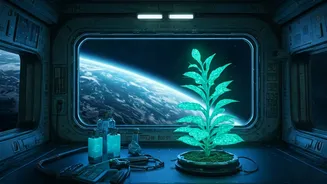
The proposed solution sounds like something out of science fiction, but it's grounded in a field called “biopharming.” The idea is to use genetically engineered plants to produce specific, complex proteins that can act as medicines. Instead of packing pills, astronauts would pack seeds. When a specific medication is needed, they could germinate the seeds, grow the plant in a contained hydroponic unit, and then harvest and process it to extract the active therapeutic compound. This “grow-on-demand” model solves the shelf-life problem entirely. Seeds are incredibly stable, lightweight, and can be stored for years without degradation. A small packet of seeds could represent a renewable, on-site factory for producing vital treatments millions of miles from home. It transforms a logistical nightmare into a manageable, biological process.
Lettuce: A Surprising Medical Breakthrough
This isn't just a theoretical concept. Researchers at the University of California, Davis, are already making it a reality. A NASA-funded project has successfully engineered a type of lettuce that produces a human parathyroid hormone (PTH). This hormone is critical for regulating calcium levels and can stimulate bone formation, making it a powerful potential treatment for the severe bone loss astronauts experience in microgravity. In their lab, the team has shown that the lettuce can be grown to produce a predictable dose of the drug. The goal is a system where an astronaut could eat a specific quantity of the plant to get a therapeutic dose. While this specific project is focused on bone loss, the same principle could be applied to produce other protein-based medicines, like human growth hormone or various antibodies, opening the door to a versatile, space-based dispensary.
Hurdles in the Final Frontier
Of course, growing a pharmacy in space isn’t as simple as planting a few seeds in a pot. Researchers still face significant challenges. First, they must prove that plants can grow reliably in the unique environment of a spacecraft, with its artificial light and microgravity. The team at UC Davis is specifically using a variety of lettuce that is known to grow well on the International Space Station (ISS) to give their project a head start. Second is containment. Since these are genetically modified organisms, it's essential to ensure they are grown in a closed, controlled environment to prevent any accidental release or contamination. Finally, dosage and purification are key. Scientists need to develop simple, reliable methods for astronauts to extract and measure the correct dose of a drug from a plant, ensuring both safety and efficacy without a full pharmacology lab on board. These are not small problems, but they are the exact kind of engineering and scientific puzzles NASA excels at solving.