







An Ancient Journey, A Modern Lens
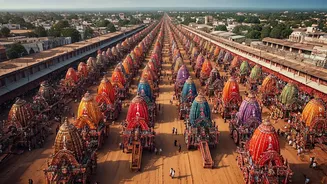
This is the Rath Yatra, or Chariot Festival, of Puri, India—an annual Hindu pilgrimage of staggering proportions, and recent drone footage has given the world an unprecedented look at its scale. Every year, typically in June or July, the city in the eastern
state of Odisha hosts one of the oldest and largest religious gatherings on Earth. The festival celebrates the journey of Lord Jagannath—a deity considered a form of Vishnu—along with his elder brother Balabhadra and sister Subhadra. The deities leave their sanctuary in the main Jagannath Temple to travel to the Gundicha Temple, their symbolic summer home, for nine days. For devotees, this is not just a parade; it is a profoundly spiritual event. It is believed that witnessing the deities on their chariots and, especially, participating in pulling the ropes, is a deeply meritorious act that can cleanse sins and pave the path to salvation.
The Titans of Timber
The chariots themselves are the heart of the spectacle. These are not permanent floats reused year after year. They are massive wooden temples on wheels, built fresh annually from specific types of wood by a dedicated team of carpenters and artisans who have inherited the craft through generations. Each chariot is a masterpiece of sacred architecture. Lord Jagannath’s chariot, Nandighosha, stands roughly 45 feet tall, painted with vibrant red and yellow stripes, and rolls on 16 massive wheels. His brother Balabhadra’s chariot, Taladhwaja, is nearly as tall, draped in red and green, while their sister Subhadra’s smaller chariot, Darpadalana, is covered in red and black. Adorned with intricate carvings, painted deities, and massive fabric canopies, these structures are temporary homes for the gods, built with precision, ritual, and immense devotion.
A Sea of Devotion
What the drone footage captures most powerfully is the human element. From the ground, the experience is a cacophony of sound—chanting, bells, and the roar of the crowd. It’s an overwhelming, immersive crush of people. From above, however, that crush transforms into a mesmerizing pattern of collective effort. The aerial view shows the thick, hand-braided coconut fiber ropes, each hundreds of feet long, being gripped by thousands of hands. It reveals the slow, determined progress of the chariots, which weigh over a hundred tons each, powered entirely by human will. This isn't a passive crowd of spectators; it is a unified force of over a million people participating in a single act of faith. The drone’s perspective strips away the individual chaos to reveal a breathtaking portrait of community and shared purpose, a tide of devotion moving as one.
Tradition Through a New Eye
The use of drones to film the Rath Yatra is more than just a technological novelty; it represents a new way of seeing and sharing an ancient tradition. For centuries, the only way to comprehend the festival’s scale was to be in the middle of it. Now, this footage allows a global audience to appreciate its grandeur without the sensory overload. It provides a perspective that was once the sole domain of imagination, artists' renderings, or perhaps, the gods themselves. This technology doesn’t diminish the sacredness of the event. Instead, it amplifies its visual poetry, highlighting the incredible geometry of faith, the vibrant colors against the urban landscape, and the sheer number of souls united in a single, centuries-old ritual. It’s a powerful reminder that while traditions can be ancient, our ways of appreciating them can continue to evolve.